
Ahhh, the time of year when busy is an understatement, yet still the desire to stop and reflect over the past year–perhaps in the twinkle of some Christmas lights with a hot mug of something sweet–is strong. The phase of feeling more stressed than blessed has passed, the excitement of Christmas Eve and morning has calmed, and now I’m enjoying the holidays in a relaxed, family-filled, grateful way. What better time to do some reflection?
 Once again, Cheryl from Meadow Mist Designs is hosting her “Best of” linky party, inviting bloggers to share their five best posts from 2016, so I thought it was a perfect time to take a look at the statistics and reflect on the highlights of the past year here on Night Quilter. I’ve put together five of Night Quilter’s “bests” for the past year (plus one personal added bonus), and I invite you to reminisce along with me.
Most Viewed Blog Post
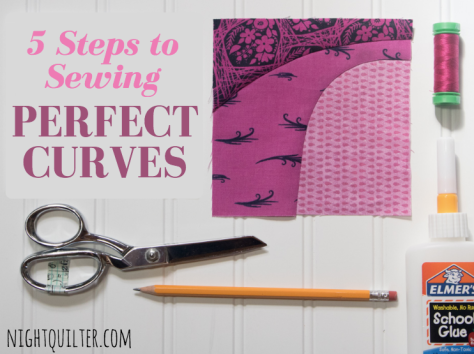 Without a new baby announcement like last year, this year’s most viewed post was the tutorial on how to sew perfect curves. I’m especially excited about this one, since one of my goals for 2016 was to tackle curves, and I feel like I made great progress in that category. I love this method as much as you do, and I’m so glad I could share this with so many of you!
Most Viewed Non-Tutorial Blog Post
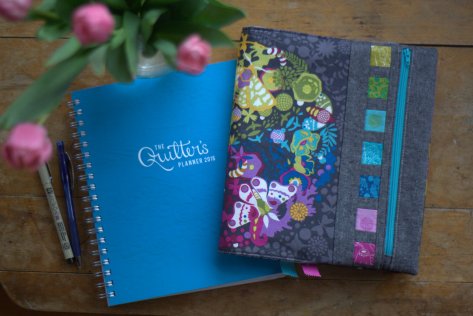 Since my most viewed post from 2016 was a tutorial, I decided to also share my most viewed non-tutorial post. In Planning a Colorful Year, I shared the Riot of Color planner cover design I made for the Quilter’s Planner (which is still available for free, here–and fit’s the 2017 Quilter’s Planner! if you haven’t gotten yours yet, I highly recommend getting one here–this planner is life changing!), as well as a giveaway for a planner. It’s hard to say whether the gorgeous melding of Alison Glass fabrics with Essex linen is what drew the most attention, or if it was the chance to win a most coveted planner, but I am proud of this post all the same and I’m glad you liked it, too.
Most Viewed Blog Post
(not including Tutorials or Giveaways)
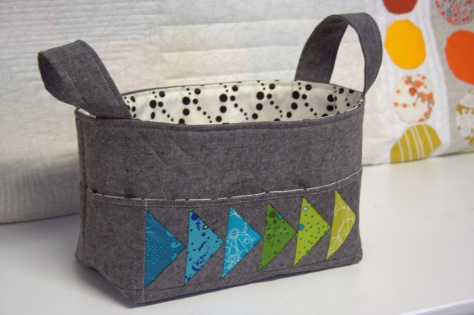 If you take all tutorials and giveaways out of the running, the one hour basket (that took me six hours to make!) was the most viewed. This was such a fun make, once again featuring my favorite Alison Glass fabrics paired with Robert Kaufman’s Essex linen, but also is a favorite since I made this basket while attending a class with quilty friend Sarah from Berry Barn Designs at one of my fabulous quasi-local quilt store, Alewives Fabrics.
Most Exciting New Endeavor
2016 was a big year of new endeavors for me, so this category requires a tie:
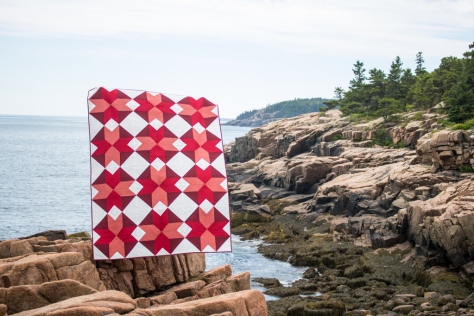
I kicked off my quilt photography business venture by doing all of the photography for the 2017 Quilter’s Planner, photographing 14 quilts and quilted projects in gorgeous natural locations along the coast of Maine. The photo above features Yvonne from Quilting Jetgirl’s lovely Starlight Crystals quilt, photographed along the coast in Acadia. Quilt photography combines three of my loves: quilting, photography, and the beauty of nature, so I’m so excited to be offering it to anyone seeking to get epic quilt photos for publication or just for fun.

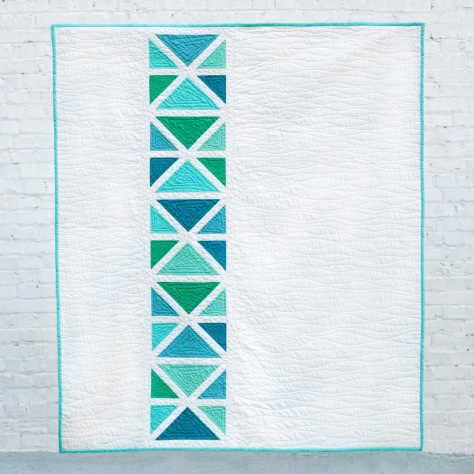 I was also one of seven quilt designers to launch Quilt Theory, kicking off with my premier pattern Ocean Path. With the enthusiasm and drive of fearless leader Michelle Bartholomew, we are working on our second round of patterns and are constantly expanding the reach of the Quilt Theory pattern cards. You can find much more information and the full line of available patterns here.
2016 Best Nine on Instagram
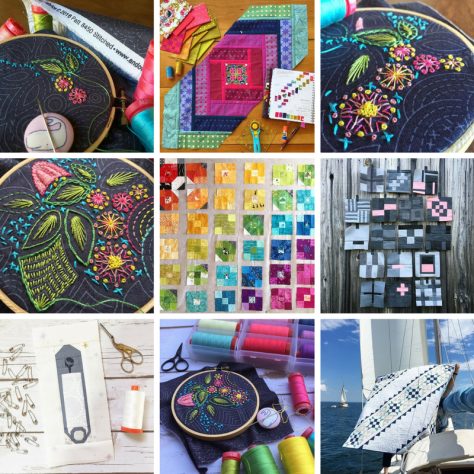 Since I love Instagram so, I would be remiss if I did not share my top viewed posts there as well. This collection is a fun one, including lots of posts about my stress-free stitch-wherever-the-wind-blows embroidery hoop, a fun Alison Glass table runner I don’t think I’ve shared here yet, a progress shot of my Eye Spy Picnic Plaid quilt, a progress shot of all of my thrifted City Sampler blocks, the free Safe with Me pattern I made in an attempt to spread positivity and support for those who need it, and a glimpse of one of my favorite quilt photos for the Quilter’s Planner, the epic sailboat shot of Cheryl Brickey’s Canvas Lines Quilt.
Favorite Project
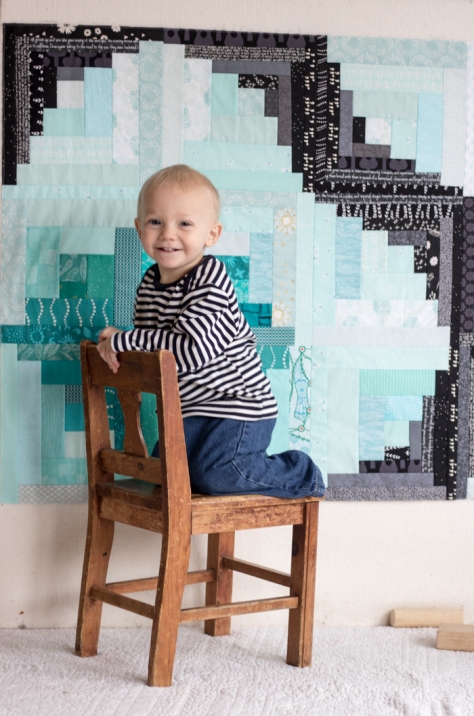 Technically this is my sixth category, but I can’t let my highlights pass without remembering the completion of the Milestone Quilt Blocks for my son Finnian. While the project didn’t make my top viewed posts for 2016, it is still the project that filled my heart the most. My little babe is now 18 months old, walking, talking, signing, dancing, jumping, exploring, and smiling his days away. His quilt top is together, and I hope to get the quilt layered, basted, quilted and bound early next year. There’s something about making a quilt for your child, marking his progress and growth with a bit of stitching, that really takes quilting to a new level. I’m so grateful that my silly husband made the crazy suggestion (fully in jest) on the day our third child turned 1 month old that I should make a quilt block each month for a photo shoot, since without that little laugh-filled exchange, this project would have never come to be.
2016 was a big year, with many new endeavors and a seemingly endless list of fun projects and adventures. I’m still working on the fine art of saying no and understanding my own limitations, since I really truly want to do it all. I’m a maker through and through. I’m hoping to keep 2017 fairly low key, focusing on finishing projects I’ve already begun, and participating in a few sew alongs with a relaxed mentality. Then again, I have some big goals I’d like to pursue, so we’ll see when and if those kick it all up a notch. I’ll write more about that in a future post, since after reflection comes planning and goal setting. I’m so glad I have my Quilter’s Planner for that!
Thank you, as always, for following along with me here, sharing in my inspiration and project progress, and creating the community I hold so dear. I hope you have a wonderful, peaceful holiday season and look forward to a colorful, productive, and FUN 2017.

 I’m calling my block Steady On, which just seemed fitting for such a classic made-by-me block. Those of you who know me know that I cannot keep anything simple, and this is a perfect case in point. This block has double improv curves, twenty (20) tiny flying geese, an hourglass block, and quite a few points that should match *just* so, all in the 12 1/2″ unfinished square block. But fear not, this tutorial has detailed photos and instructions on how to make each component of the block, and breaking it down into manageable chunks makes this block come together quite smoothly (Spoiler: we can make some of the flying geese 4 at a time!). There’s something about the determined light colored geese headed bravely into the dark and improvy unknown that urges me to encourage them… Steady on, now! That same encouragement goes for you, since I would LOVE to see you tackle this block and come out victorious (tag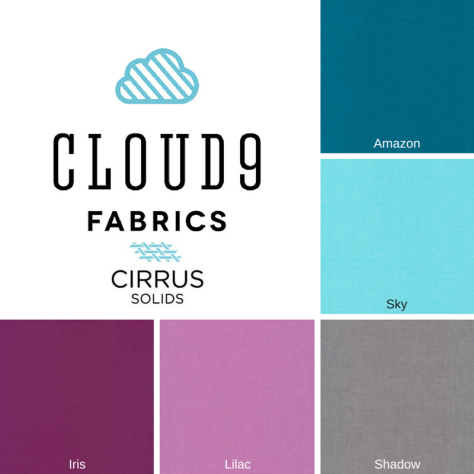

 For this step, you will need your 5 1/2″ squares of Iris, Amazon, and Sky, washable school glue and tip, a marking pen or pencil, scissors, and an iron and pressing surface. To make the double-curved quadrants for this block, follow my tutorial on easy curved piecing using a visual layering approach and glue basting
 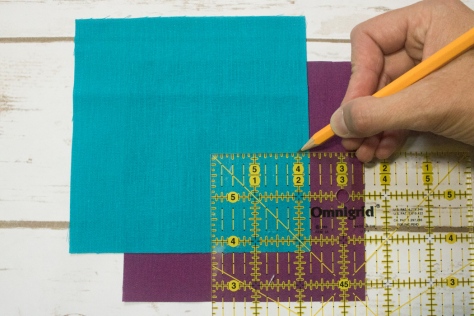 Since this method begins from the bottom up, start with Iris and Amazon. Mark the Amazon square 2 1/4″ up along both sides from the bottom right corner. Make sure your mark extends 1/4″ in from the edges before beginning the curve. This will be your sew line, not your cut line, so by measuring the 2 1/4″ we are ensuring our seams will match up, even though the flying geese are exact and the curves can be improv. (Note here that if you are using fabric with a right and wrong side, you want to be marking the wrong side of the fabric. With the Cloud9 Cirrus Solids that’s not important).
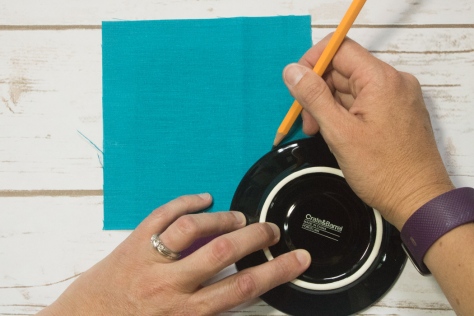 Draw an improv curve from marked point to point, or trace a perfect curve using the edge of a small plate or glass. Make sure your curve begins and ends at your marked points 2 1/4″ up from the corner.
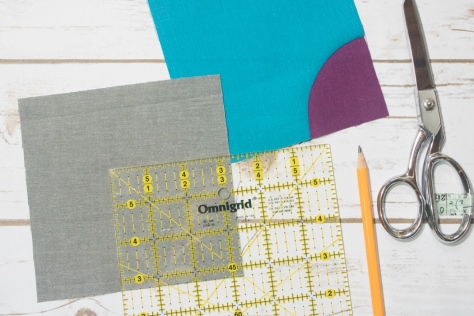 Next, grab your Shadow 5 1/2″ square and mark 3 1/4″ up both sides from the bottom right corner. Again, draw your curve as desired, connecting from marked point to marked point, and using that line as the sew line.
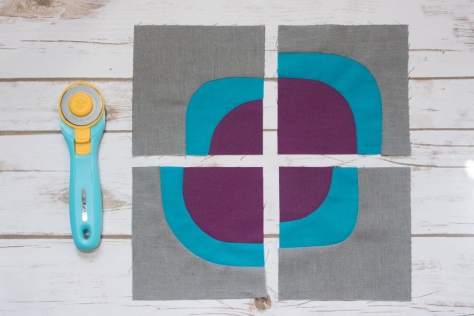 Make four quadrants, measuring 2 1/4″ up on the Amazon square and 3 1/4″ up on the Shadow square for two of them, and measuring 3 1/4″ up on the Amazon and 4 1/4″ up on the Shadow square for the other two. Admire your smooth curves, and set those blocks aside for later!
 Place two 1 7/8″ Iris squares in the top right and bottom left corners of a 3 1/4″ Sky square as shown. Using your fabric marking tool of choice, draw a diagonal line from the top right corner to the bottom left corner. I love my Hera marker since it doesn’t actually mark the fabric, but makes a clear guide line.
 Sew 1/4″ from either side of the drawn line. Press with a hot iron to set the seam (notice that I didn’t do this step? tsk tsk).
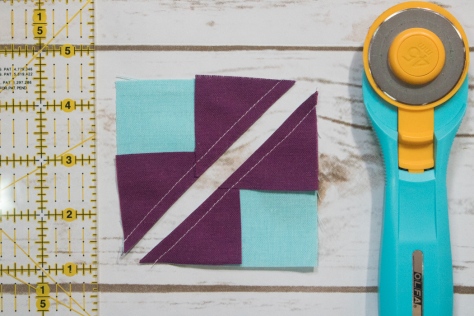 Cut along the drawn line.
 Press the small Iris triangles outward, with seams pressed toward the dark fabric. Then place another 1 7/8″ Iris square in the corner of each unit, and mark a diagonal line as shown above.
 Again, carefully sew 1/4″ from either side of the drawn line. Cut along drawn line.
 Press open, with seams toward darker fabric.
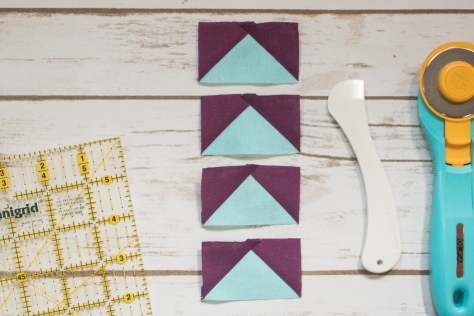 Trim to 1 1/2″ x 2 1/2″ and set aside.
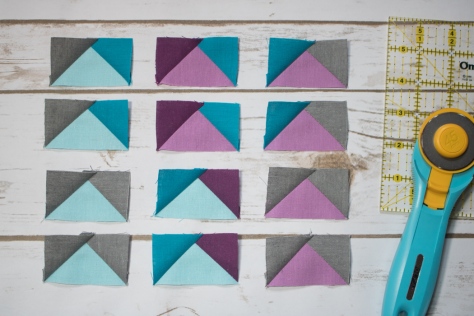 Grab your 1 1/2″ squares and 1 1/2″ x 2 1/2″ rectangles and lay them out to help plan which corners should be positioned on each rectangle. Use the finished flying geese above to help plan before you start sewing.
 To make a flying geese block (or would it be flying goose?), position a 1 1/2″ square right sides facing the right top corner of a 1 1/2″ x 2 1/2″ rectangle. Draw a diagonal line as shown above.
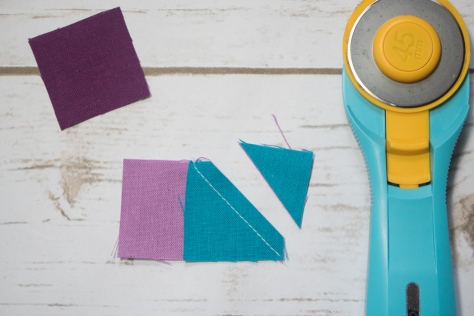 Sew along the line and then trim a 1/4″ seam allowance.
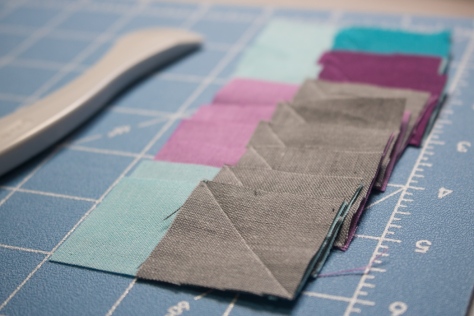 I like to get mine all paired and drawn so that I can chain piece each side.
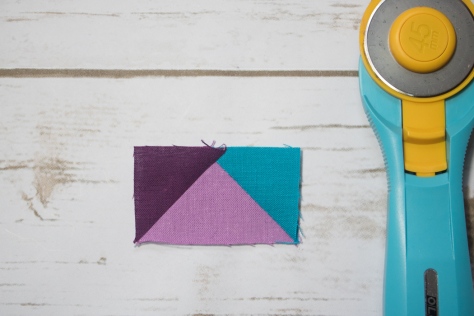 Repeat with the other 1 1/2″ square on the top left side of the block. Press seams open or up toward the corner.
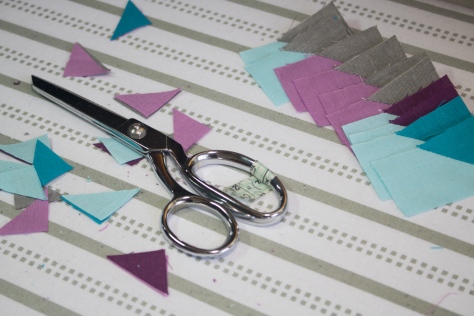 Time saving tip: I cut my 1/4″ seam allowances with scissors while pressing. As long as you are accurate with a pair of scissors, it takes much less time than rotary cutting, at least for me.
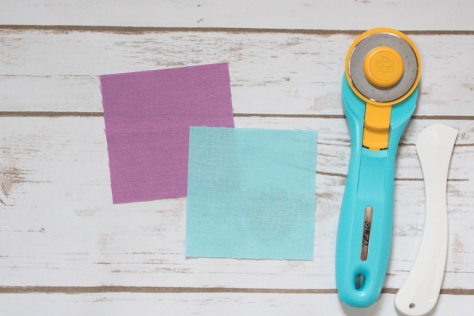 Finally, let’s make that center hourglass block. Grab your 3 1/4″ Lilac and Sky squares.
 Place right sides together and mark a diagonal line. I like to pin my pieces together since we are working with such a small scale. If you’d prefer some wiggle room, you can begin with 3 1/2″ squares and trim to size when you’re finished!
 Sew 1/4″ from either side of the drawn line. Cut along the drawn line.
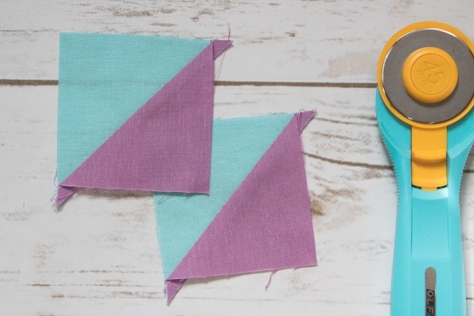 Press toward darker fabric. You will have two half square triangles (HST).
 Place HSTs right sides together, with the Lilac half of one facing the Sky half of the other, and nesting the seams.
 Draw a diagonal line perpendicular to the existing seam line, again pinning to keep the pieces in place while you sew.
 Sew 1/4″ on either side of the drawn line. Then, cut along drawn line.
 Press seams open. You will have two hourglass blocks, but will only need one for this block. Save the other one for your next Steady On block!
 Trim to 2 1/2″ square. Set aside.
 Now that you’ve made all of the components, it’s time to sew the block together! Arrange all of your pieces as shown above, paying careful attention the positioning of the flying geese in relation to the large and small curves on your curved quadrants. There should be two Iris flying geese corners next to small curves and three Iris flying geese corners next to large curves.
 Sew the top five and bottom five groupings of geese together, and sew the center horizontal strip of geese and center hourglass block together.
 Perfect points tip: When sewing the flying geese together, keep the piece with the goose point on top. As you’re sewing, make sure your sewing machine needle sews exactly through the “x” that marks the point of the goose, or if anything, slightly to the right (above) the point. This way you won’t lose any points!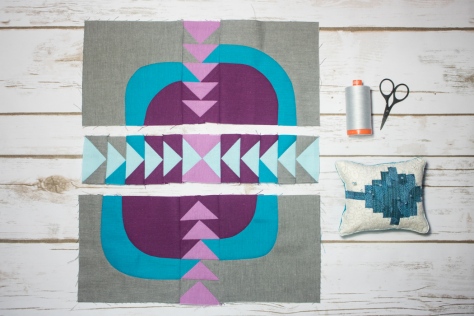
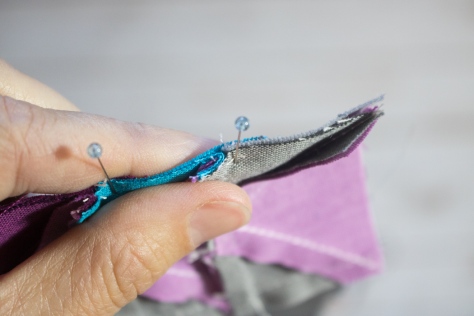 Next, sew the top left and top right curved quadrants to the top grouping of geese, pinning just after each seam that needs to match.
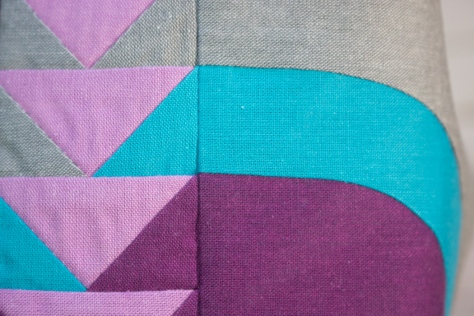 When aligned properly, the geese corners should flow into the curved piece perfectly–that’s why we so carefully marked our curve starting distances with our improv curves!
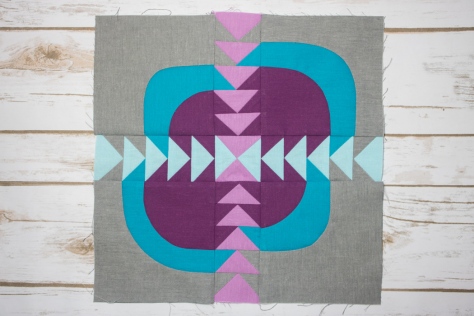 Finally, sew the top and bottom panels to the center horizontal strip, again pinning just after each important seam match. Press toward the less bulky sides (the curved quadrants), and viola! Steady on…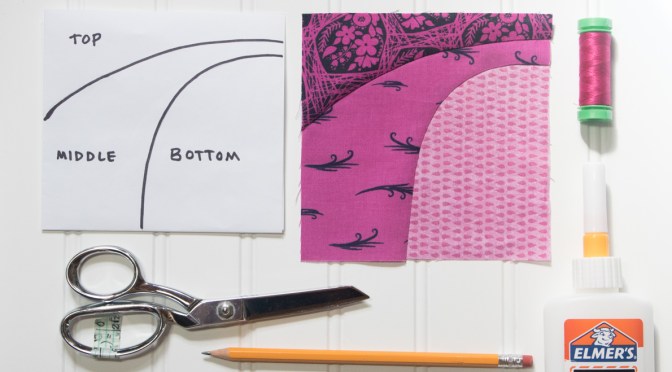
 I first saw this method being used by
 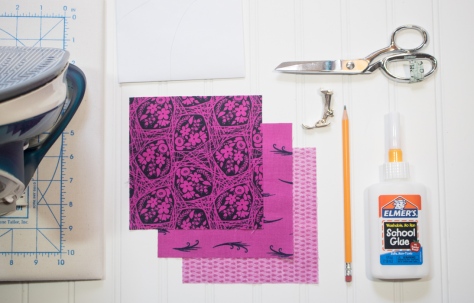 So let’s get started! First, gather your supplies. You will need:
 Before you begin, decide generally how you want your curves to look. I like to sketch mine out on paper more for a visual than for an exact plan. Think of your fabrics in terms of layers: the bottom is the inside of the curve, moving upward and outward. Keep in mind that if you want to have a convex curve next to a concave curve, simply switch the way you view your “top” and “bottom” layers. The inside of the curve is always the bottom, and work from the bottom up.
 Draw your curve on the wrong side of your top (or in this case, middle) fabric with a pencil or other light fabric marking pen. If you want your curve to be exact, you can trace the line from your paper sketch by holding the fabric and paper up to a window or other light source. Be sure that the right sides of both the paper and fabric are facing away from you, since you want the line drawn on the wrong side of your fabric, but also want the curve to go in the proper direction.
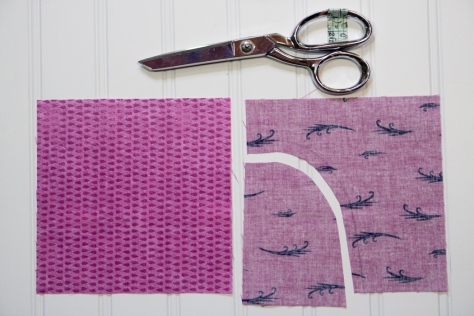 Next, cut between 1/4″ and 3/8″ away from the inside edge of your drawn line. This is your seam allowance.
 Clip your curves to help make your curve smooth. Be sure to cut only halfway to the drawn line, not all the way to the drawn line.
 Next, carefully press the seam allowance along your drawn line. Take your time here to make sure your curve is pressed smoothly and exactly along your drawn curve.
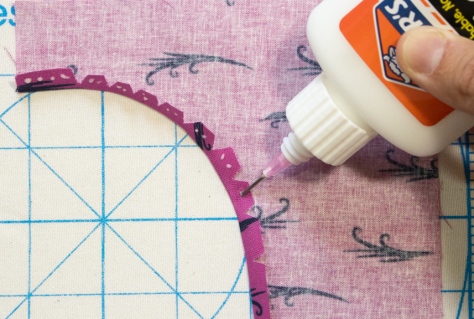 Now it’s time to glue baste this curve onto your bottom layer. Using a fine glue tip and washable school glue, create a small beaded line of glue along the seam allowance. Carefully lining up the outer corners of your squares, layer the middle fabric (with right side facing up and your cut, pressed, and glued seam allowance tucked under) on top of the bottom piece of fabric. This step is why I like to begin with three squares that are the same size. It makes positioning my curves as easy as pie!
 Press with your fingers, making sure the seam allowance is in the right spot and fully folded under. Press with a hot iron to set the glue. Admire your perfect curve… but it’s not sewn yet! Just one more step.
 Once the glue has been set and fabric cooled off, carefully lift up the top layer of fabric to expose the seam allowance. I use my zipper foot with my needle moved all the way to the left, since the narrow foot helps ease around tight turns. Carefully and slowly sew along your drawn line.
 As you sew around the curves, carefully move the top fabric out of the way, being sure not to allow folds or puckers to form under the needle. Backstitch a bit at the beginning and end of your sewn line to secure the stitches.
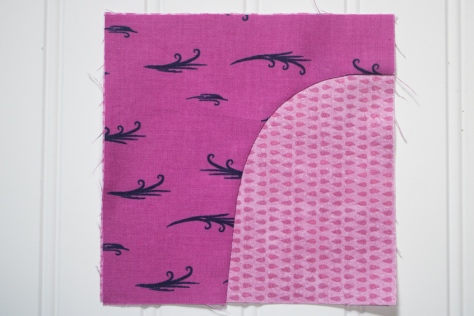 Viola! Press again and you have a perfectly sewn curve!
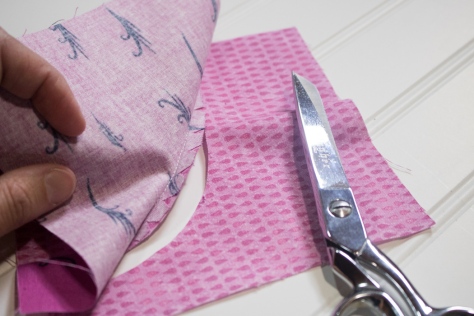 Trim away the bottom fabric that extends beyond the seam allowance, and save for your next scrappy project.
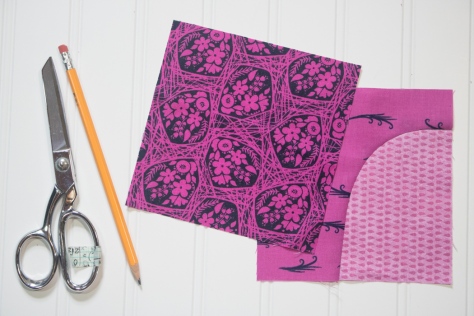 Repeat those five easy steps for your other layers: Draw, Cut, Press, Glue Baste, Sew.
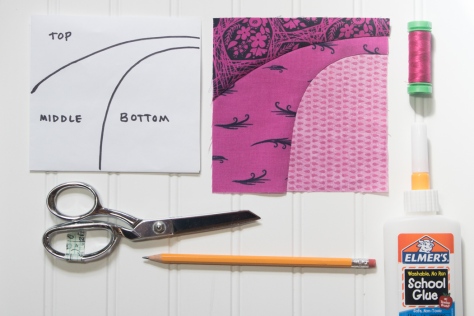 There you have it. Smooth curves, either traced and perfect, or free cut and improv.
 Night Quilter