Today I’m taking part in yet another fun, quick sew along hosted by Fat Quarter Shop. Kimberly from FQS teamed up with Sherri McConnell once again to bring you a video tutorial for a really simple and cute pin cushion, which is being released today. I definitely will be making more of these!
I really love clear video tutorials since I am very much a visual learner. Seeing each step helps make the process smooth and easy to complete without hang up or confusion. That, to me, is a big win!
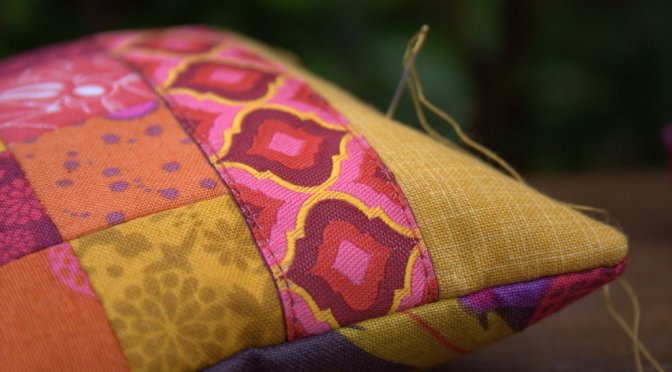
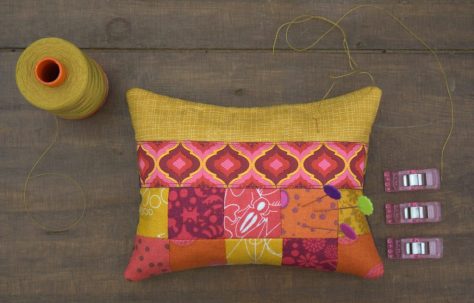
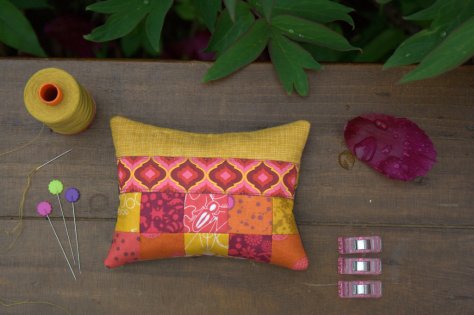
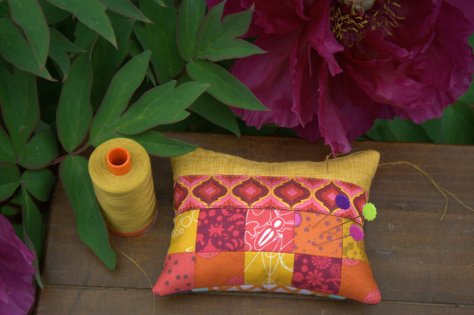
I decided to make my pin cushion with a range of warm Alison Glass Sun Prints 2015 and 2016, and once it was finished, it begged to be photographed out in the garden with the peonies. Such vibrant colors need to be in colorful company.
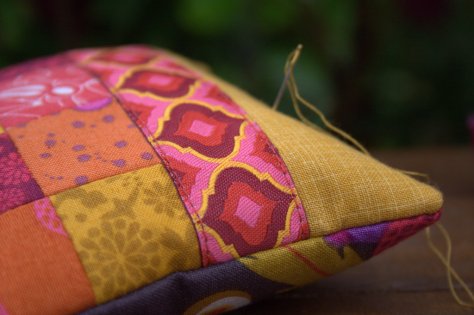
I used a Tula Pink ribbon I won in a giveaway from Renaissance Ribbons a year or so ago as the ribbon detail, top stitched with Aurifil 40wt 2230-Medium Peony (so fitting!). I topped the pin cushion with Robert Kaufman Quilter’s Linen, which is a fabulous all-purpose blender fabric that happened to coordinate wonderfully. Aurifil 50wt 5022-Mustard was the perfect thread for hand stitching the opening in the Quilter’s Linen closed, too. I just love when perfectly coordinating fabrics and thread can be found in my stash.
I backed the pin cushion in Ex Libris Bookplate in Charcoal by Alison Glass (Andover Fabrics), and really would be tempted to use the pin cushion upside down every so often, it’s so pretty. This pin cushion is not for me, though, so the recipient can do with it as she pleases!
This is the first pin cushion I’ve stuffed entirely with crushed walnut shell, at Sherri’s suggestion, and I really like the sturdiness and ease with which pins go into it. I bought the crushed walnut shell from a quasi-local, fabulous quilt shop, Clementine in Rockland, Maine months ago but had not yet had a chance to use it. Leah at Clementine suggested the crushed walnut shells since the oils from the nut shells help keep the pins and needles sharp and rust free. They also provide a nice, sturdy base for your pins and needles.
Check out the video below and make your own pin cushion if you want! There’s no such thing as too many pin cushions, right?
Be sure to visit the other bloggers in the hop to help spark your inspiration and see what they did with this pin cushion:
Ahh! Summer is upon us! My daughter has mere days left of school before summer break is officially here! That means all three kids home all day, every day, which in turn means time to take lots of day trip adventures! Summer also means lots more opportunity for slow stitching, and a need to have some hand stitching available at all times. We all know that the day I forget my handwork will be the day all three kids somehow fall asleep in the car on the way to some adventure!
My portable hand stitching kit this summer consists primarily of English Paper Piecing (EPP) hexies and some experimental embroidery-quilting projects.
After a lull in my Carolyn Friedlander modern hexies project progress, I’m ready to pick it up again and baste more hexies! While 2 1/2″ squares work just fine for EPP hexagons, I really enjoy the neatness that starting with a hexagon of fabric provides.
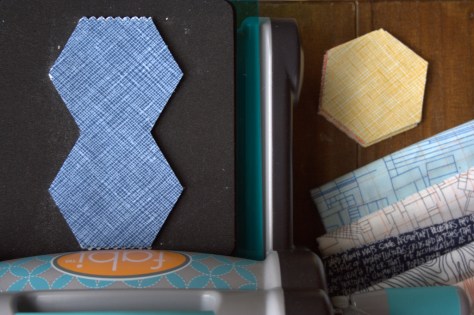
Nine (9) charm squares lined up on top of the Sizzix 1 1/2″ hexagon die. Pass it through….Viola – 18 hexagons ready for basting
This is another time when the Sizzix die cutting machine comes in handy. It doesn’t take long to cut a whole bunch of fabric and cardstock hexagons for slow stitching on the go. I use the BigZ Hexagons with 1 1/2″ sides die to cut fabric and BigZ Hexagons with 1″ sides die to cut cardstock hexies and I’m ready to roll.
A lovely stack of fabric hexagons ready to baste. I need to cut a few more cardstock templates, but this will do for now!
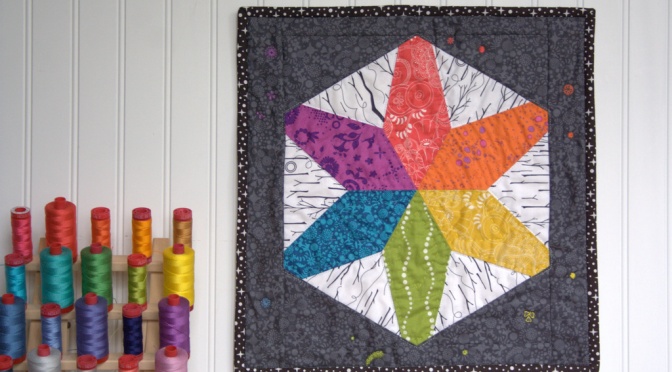
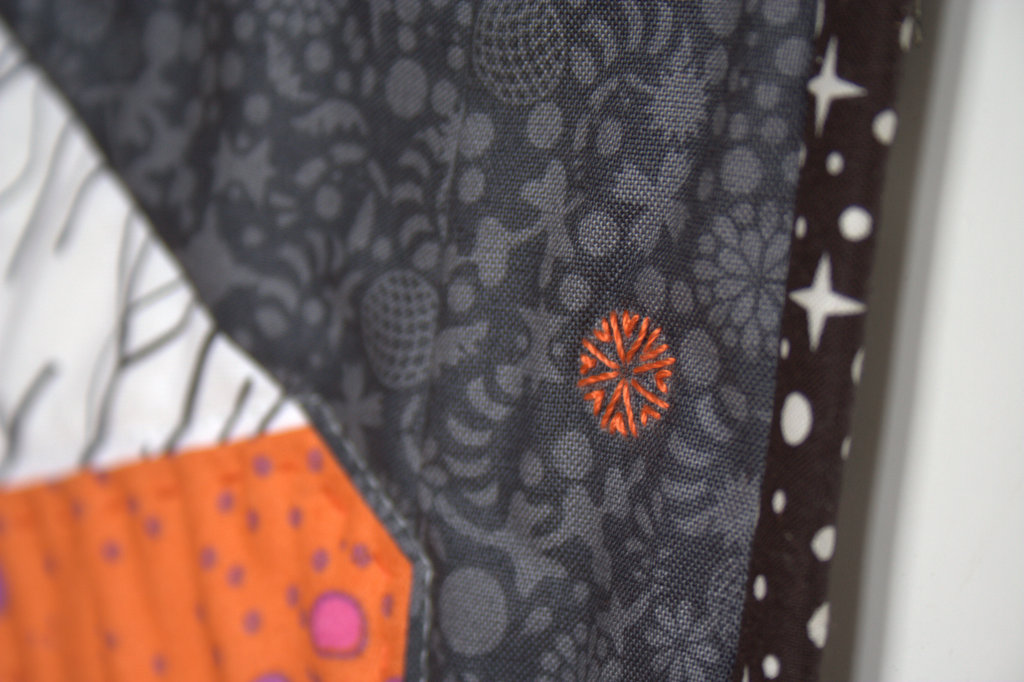
I am also continuing to add embroidery quilting to my Rainbow Hex Star mini, as well planning a couple small embroidery quilting experimental projects. My goal is to find a way to get the back to look as neat as the front. Practice, right?
Slow stitching on the go is not the only slow stitching I’m looking forward to this summer! I’m also officially registered for the Slow Stitching Retreat hosted by Sam at A Gathering of Stitches this August. I can’t wait to slow down and sew with Sam, Chawne Kimber, and Alison Glass. I’m doubly excited since I will also be leading yoga on the retreat! Just imagine… slowing down, breathing deeply, stretching out, learning from amazingly talented and inspirational quilters, and slowly stitching in the sun, rocking on the rocking chairs out on the porch in the calm, cool woods of Maine. You can read about my experience dropping in on a day of this retreat last summer HERE. I am very much looking forward to spending the full four days rejuvenating my soul with some slow stitching in inspired creative company. Are you coming!? I sure hope so!
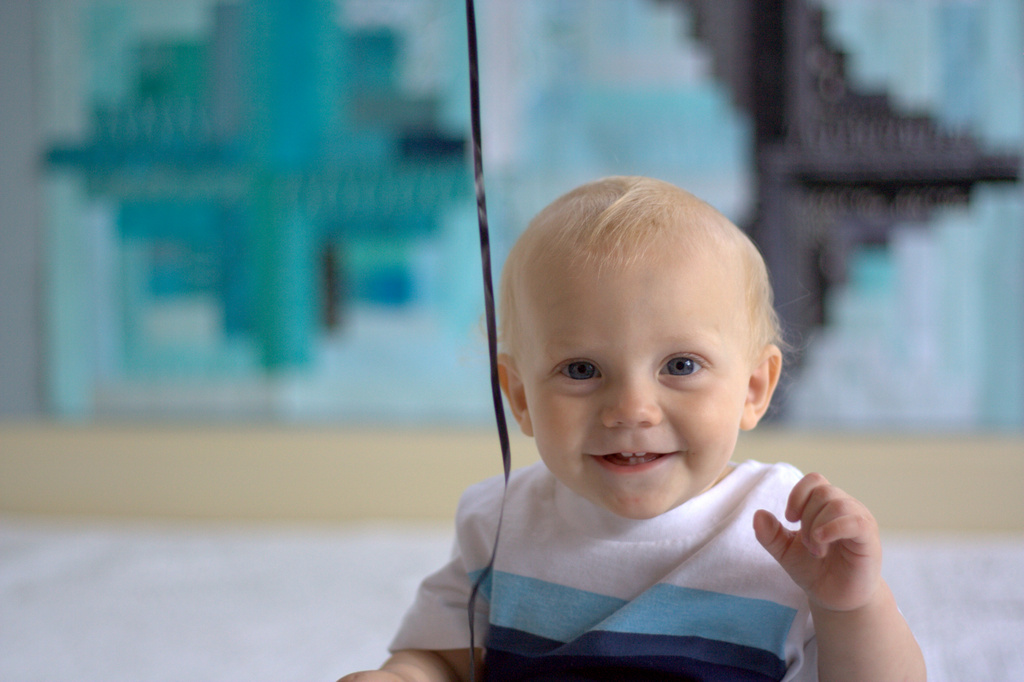
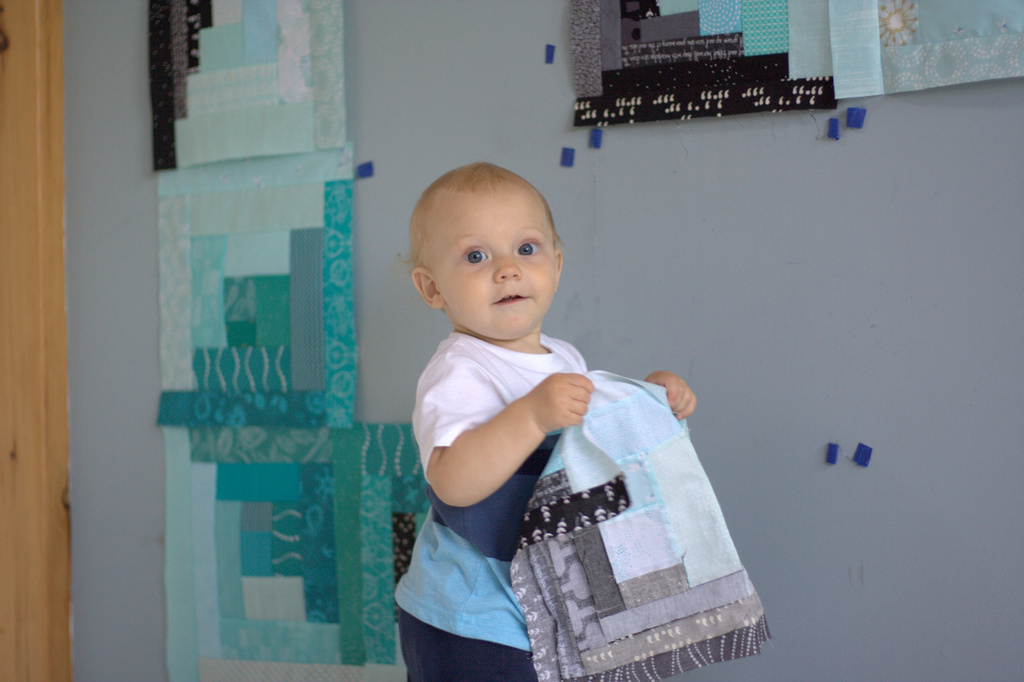
And just like that, all of the blocks for Finn’s milestone quilt are finished and my baby is officially one year old. They say “babies don’t keep” but somehow it feels like the past year flew by especially quickly. I won’t even try to pretend I won’t miss this project dearly now that it’s mostly finished. I do still need to piece the top and quilt it, so no worries–you haven’t seen the last of Finn and his quilt!
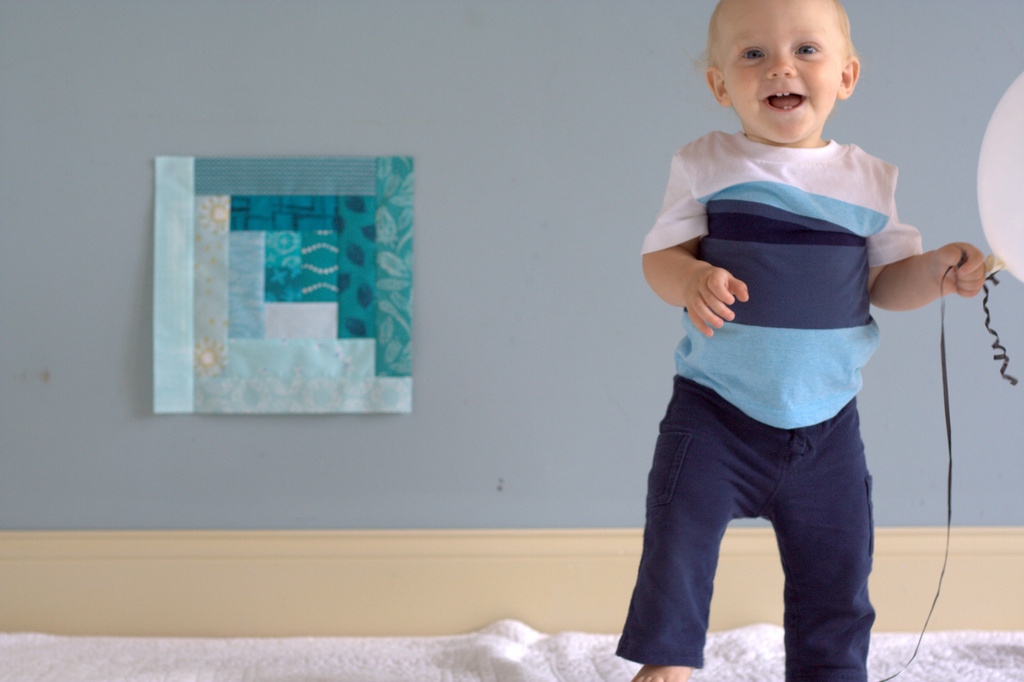
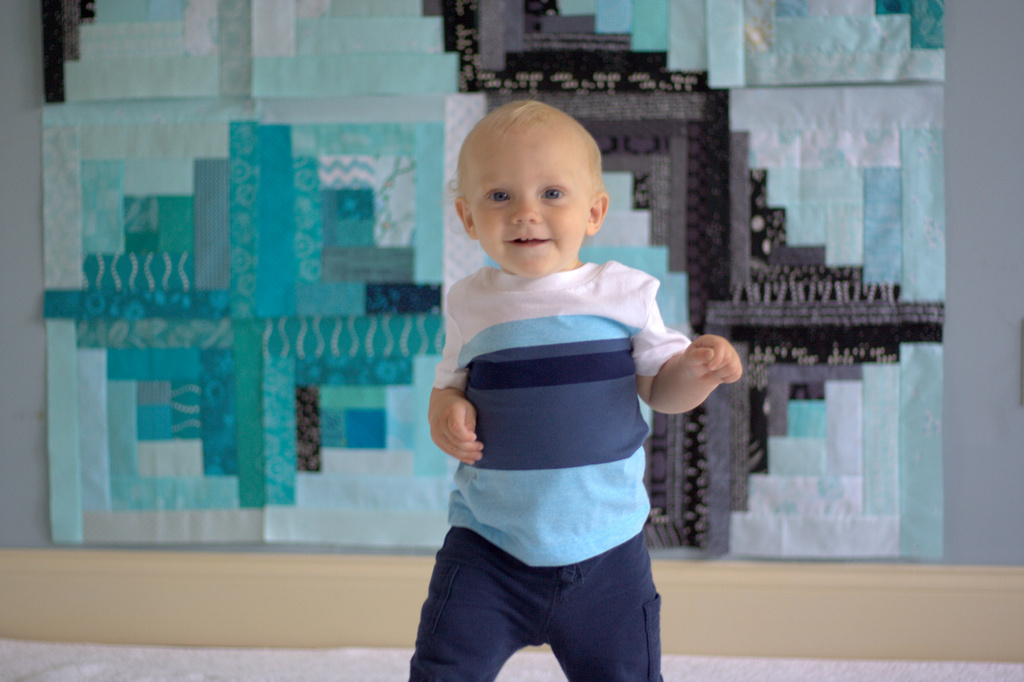
Within the past week, Finn has fully mastered walking and now prefers it over crawling. He joyfully walks circles around the house, his wobbly steps getting stronger and smoother by the day. This joy of walking certainly made this photo shoot the most difficult yet! I got one, only one, photograph of Finn relatively near his final quilt block, and while it’s not as clear as I’d like, it’s staying.
Twelve months is 12 months, and not even mommy’s most sincere and pleading attempts will keep a newfound walker from walk, walk, walking! Just as a reminder, here is Finn with his very first milestone quilt block, 11 long months ago:
Isn’t it absolutely mind-blowing how much babies grow and learn in such a short time!? Life is an amazing thing.
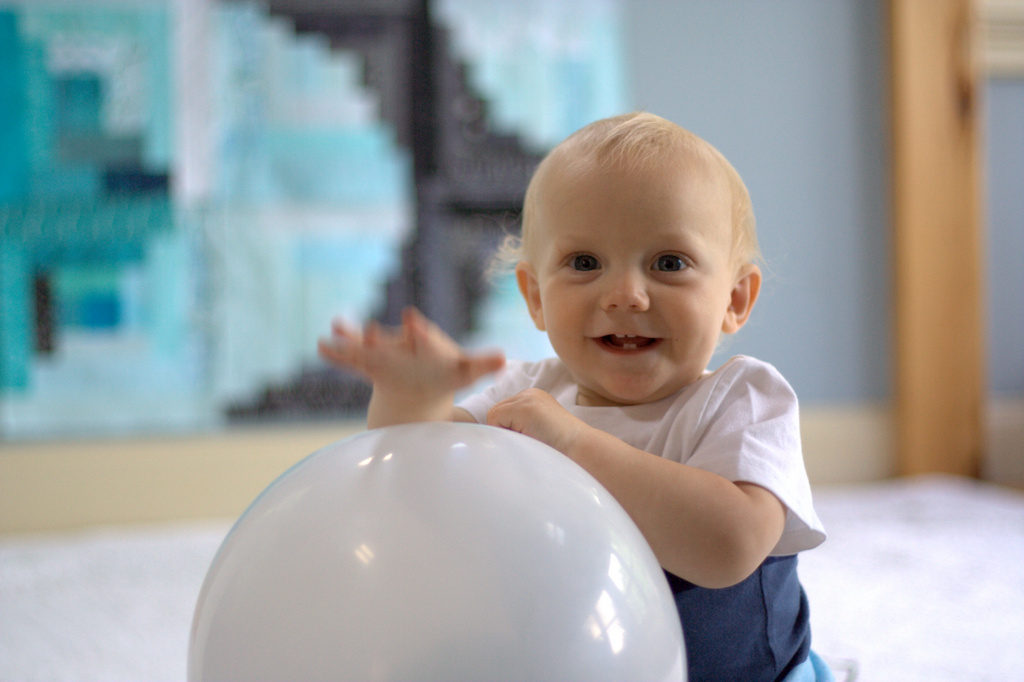
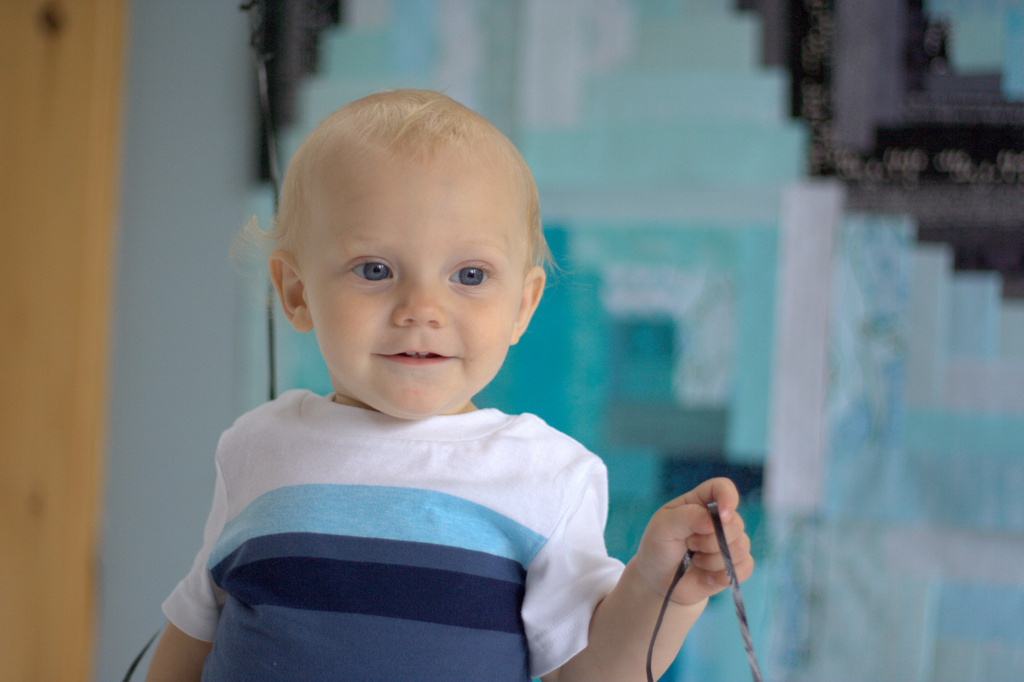
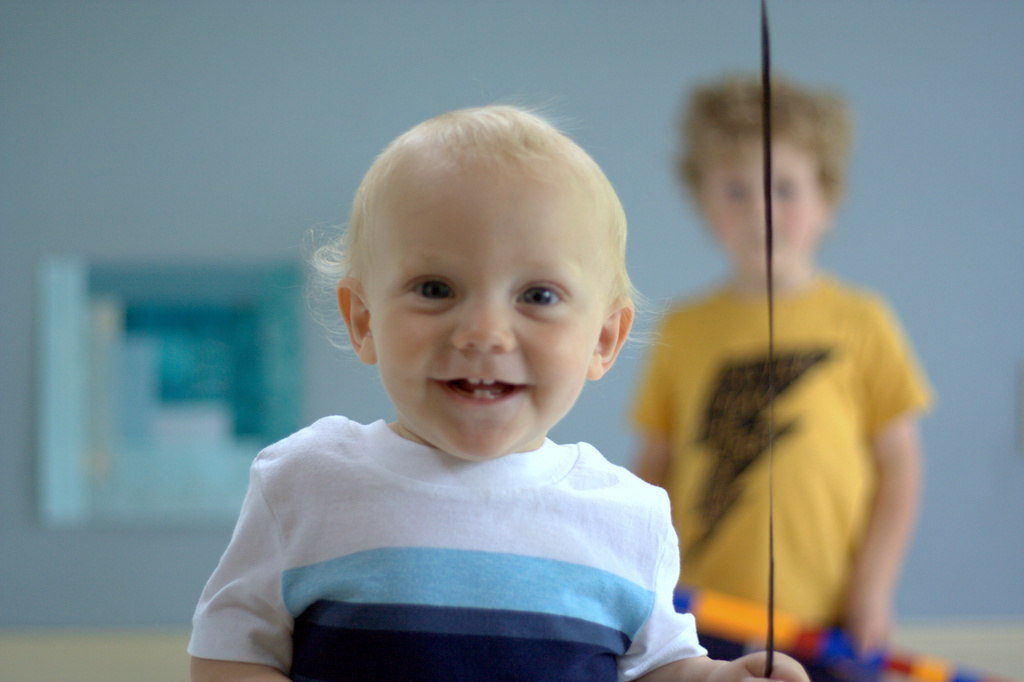
My big kids brought home a couple of balloons from their cousin’s first birthday this weekend (we had a full family birthday weekend with both Finn and cousin Reagan born 26 hours apart), and they have become the favorite toy for all three kids. (Safety note: Yes, I know that balloons are not technically safe for babies, so I will reassure you here that I only allow Finn to play with the balloon when I am directly supervising him!) I figured giving Finn something fun to hold was my best bet at having him stand still for even a moment.
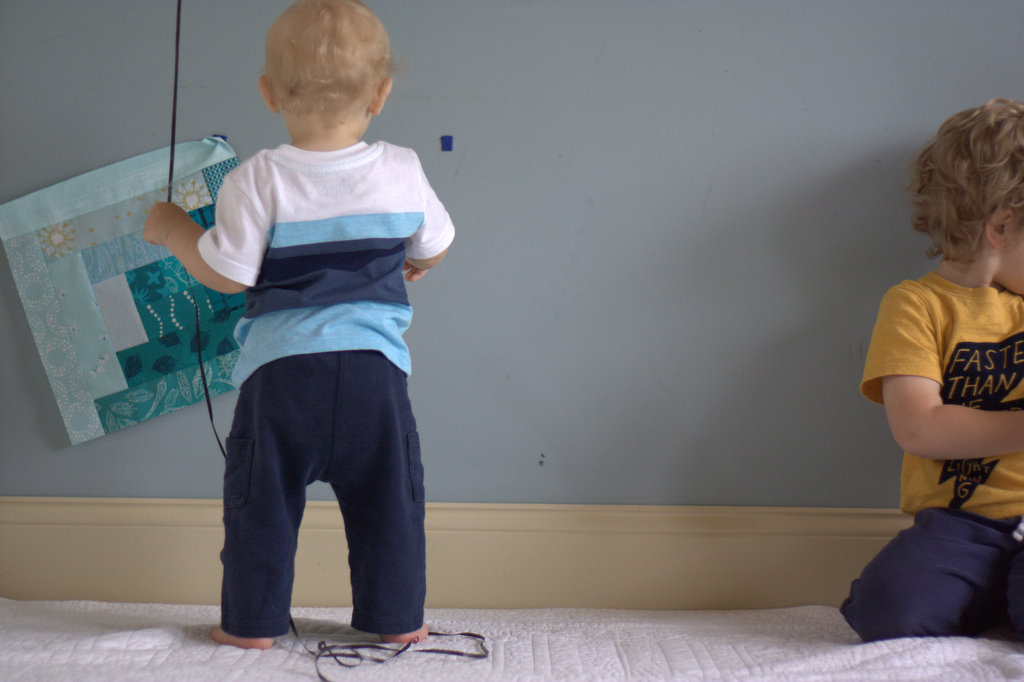
Even still, Finn would rather walk around than stand still, despite my best efforts. C’est al vie. Such is life with a brand new walker!
Add an eager almost-four-year old big brother helper, and the majority of my photos looked like this:
or, more accurately, like this:
This is part of what I have loved about this project, though. It has given me an opportunity to sit down, reflect, and write about life in the current moment. By documenting each month of my baby’s life, I’m also documenting our life as a family. With our busy lives, how often do we take a moment to write about our day? I have loved that this project has given me the motivation to write, reflect, and document the joyful milestones in Finn’s first year.
Finn continues to have a sweet and joyful disposition, complete with his newfound ability to express frustration and flop himself face down, crying, on the floor. Overall, though, he is a happy boy and a super helper. He loves to help me unload the dishwasher, taking out each utensil and holding it up for me (as long as I’m quick enough to take it within a second or two). When he does that, I always say “Thank you!” and now it sounds like he says, “Thank you!” right back. This morning while I was getting dressed, he joyfully opened my dresser drawer and started taking out folded clothes, tossing them on the floor one at a time and saying “thank you” after each one! Oh, the innocence of babes!
Finn has helped take these blocks off the wall for the very last time. Next up is squaring up the blocks and sewing the quilt top together. I’m going to give myself a month in which to do it, since it feels like an attainable goal. Setting realistic goals is still something I’m continuously working on, and something this project has helped with greatly. As much as I may have itched at times to make extra blocks, or up the ante to two blocks per month, I’m SO glad that I stuck with my original plan of one block per month, since deadlines have a funny way of sneaking up on me. Sure, it took an entire year, but all of the blocks for Finn’s quilt have been made! A finished quilt is just around the corner.
For those of you new to this project, you can see the full quilt layout plan, HERE in the 3 month post. The blocks are all completely finished now, and just as planned! You can see the full progression of Finn and his quilt’s growth HERE or by clicking the “Milestone Quilt” tab at the top of my blog. Thank you for joining me on this journey! I’m not considering the journey over just yet, since I will check in with quilt finishing progress, too, with Finn’s help of course!
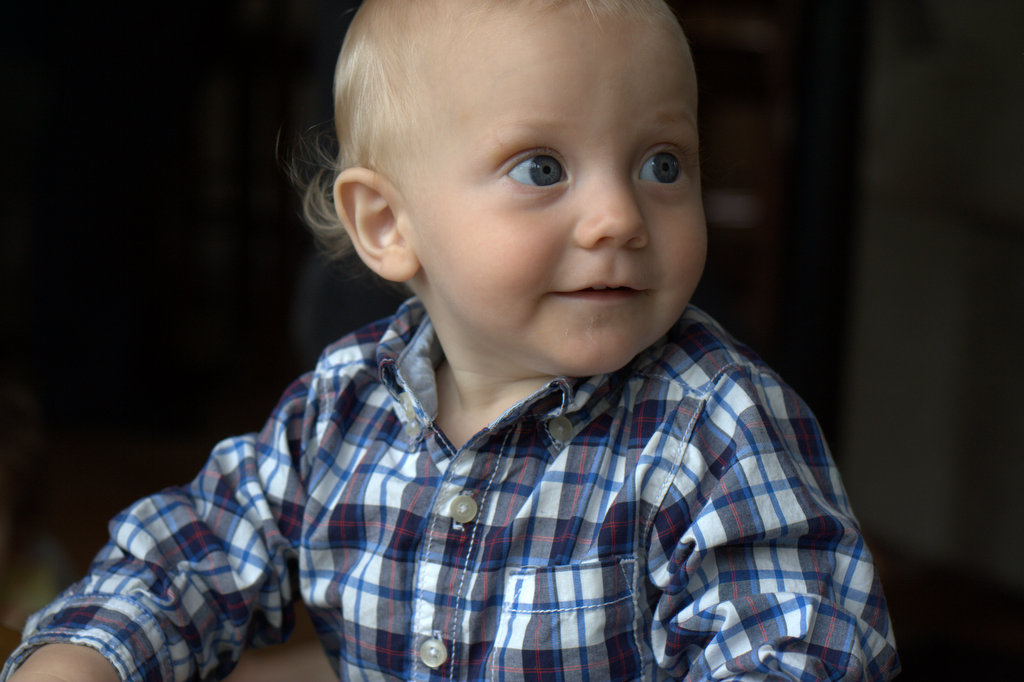
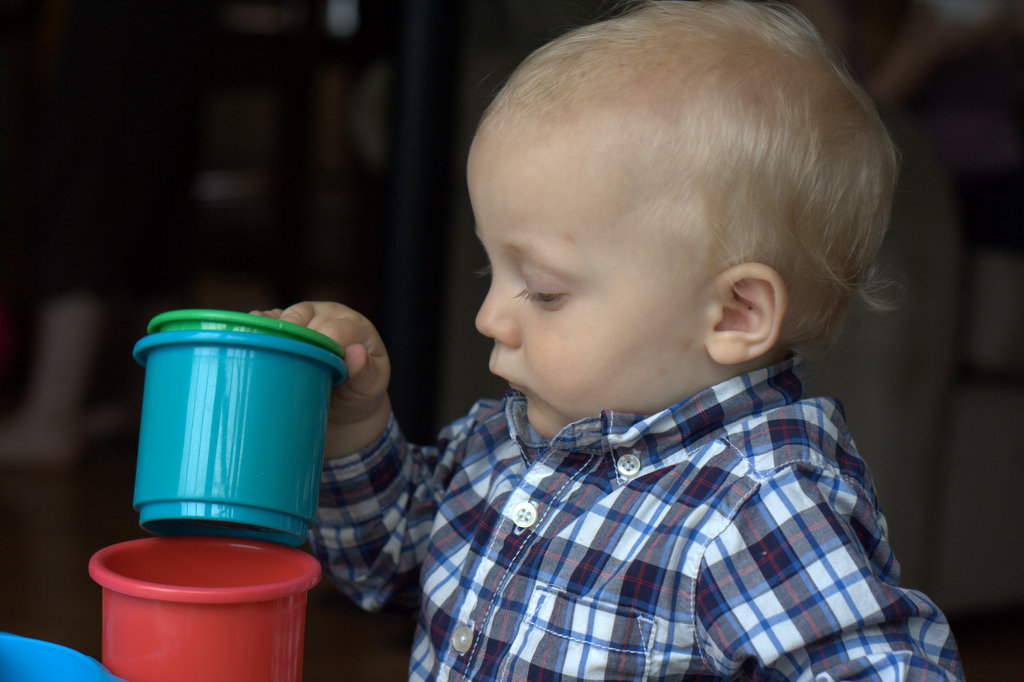
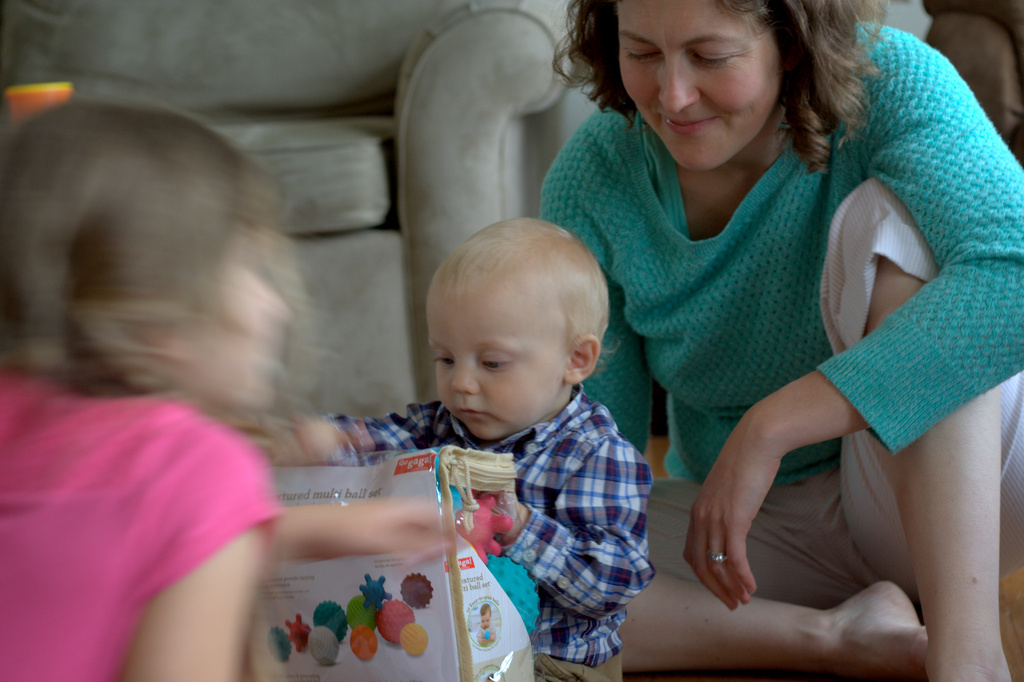
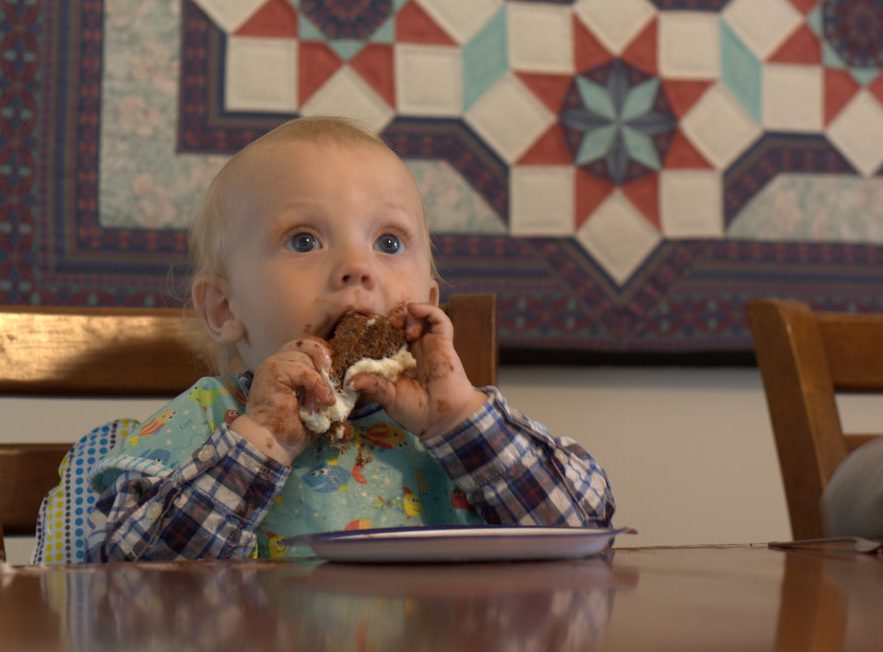
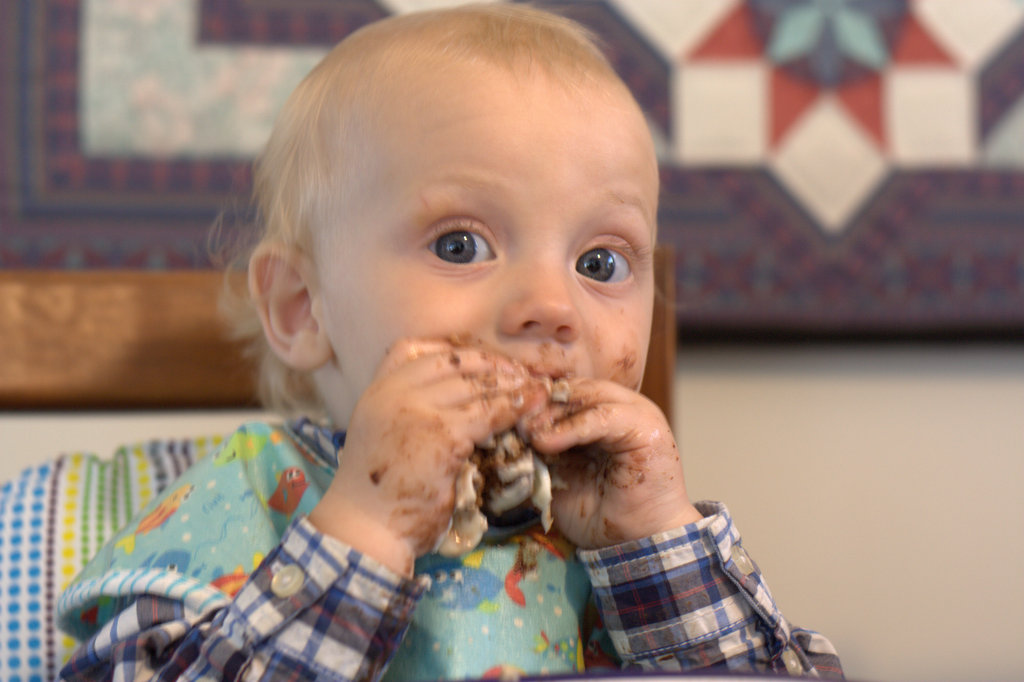
I’ll end this post with a few peeks from Finn’s first birthday party. He had such a great time!
Cheerful boy + good light = sweet shot!Figuring out those stacking cups!Those eyes!The big sibling blur during gift opening. Big siblings are great gift helpers!Birthday cake!“Oh yes, I am eating it all!”
Here’s to many more years of growth, joy, and family fun!
Ahh, Friday! We love Fridays in this house, since not only is it the last day before the weekend, but it also means family movie night. I make homemade pizzas, we set out picnic quilts in the living room, and we have a pizza picnic while watching a movie. After pizza, there’s a short intermission for popcorn making and we enjoy the rest of the movie with huge bowls of popcorn and buttery fingers. My husband has a bit of a thing for popcorn, so he makes enough to feed a small army, which I suppose we are becoming as the kids get older! While this week had its share of frustration, I also finally finished and shared two projects. A week with one finish is great; a week with two finishes is worth celebrating!!
I love linking up with Crazy Mom Quilts’ Finish it Up Friday to share in the celebration of finished projects in the quilting community, so I figured I’d write a summary post this week so that I could link up with just one post instead of two. I also have a great giveaway sponsored by Fat Quarter Shop to share to help kick off the weekend!
So here we go–my finishes for the week!
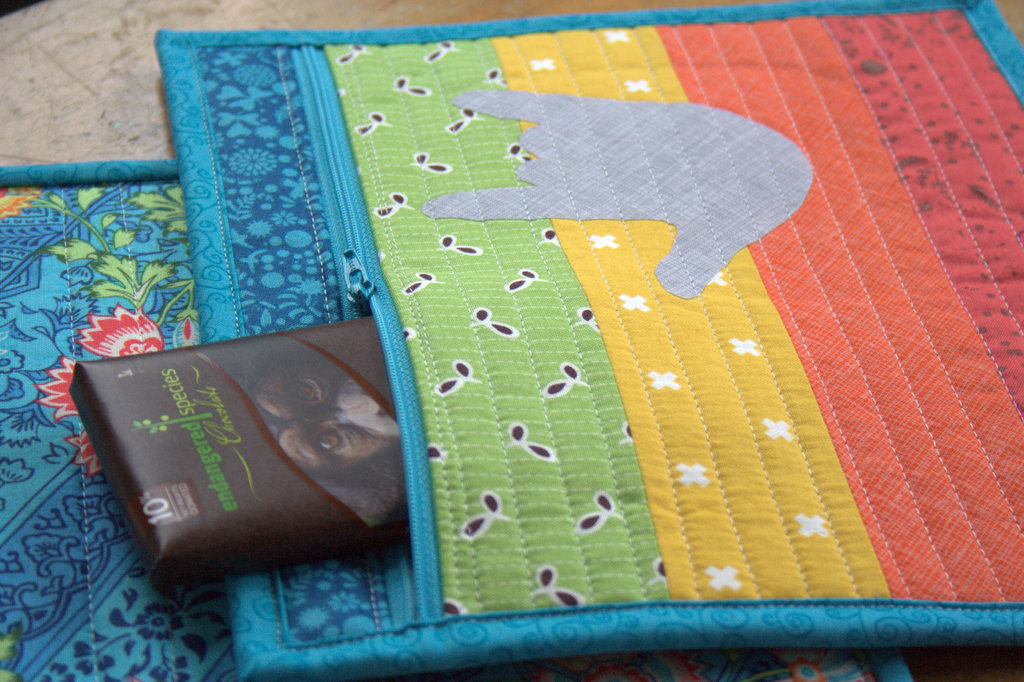
I finished three cute Amy Butler-inspired rainbow zipper bags as end of the year teacher gifts for my son’s preschool teachers and communication facilitator. There is a great video tutorial posted by the Fat Quarter Shop so that you can make your own. You can see and read more about my zipper bags HERE.
I also finished a volcano-inspired quilt with Oakshott’s new Lipari fabric line. This was a much longer term project, taking about 18 hours of work to make, start from finish. I share a tutorial so that you can make your very own Vesuvius quilt if you want! Check it out HERE.
Giveaway!
And now, for the giveaway! Thanks to the Fat Quarter Shop, one of my lucky readers can enter to win a Tula Pink Throwback fat quarter bundle of 20 fat quarters! The bundle includes some of the most popular prints from Tula’s collections over the past four (4) years, and would be a great stash builder for any modern fabric lover, whether you’re a Tula troops die hard who would pay a premium for these prints on ebay or not. There are also many fabulous opportunities for meticulous cutting with these beauties!
To enter the giveaway today, tell me–are you a fabric designer fanatic, willing to pay top dollar for rare out of print fabrics? or are you happy using whatever gorgeous fabric is available now, regardless of designer? I’m curious, since while I consider myself to be in the latter category, I could definitely see myself paying more than market value for *some* rare and beloved out of print fabrics. Leave a comment and make sure I’m able to get ahold of you if you win. If you’re a follower of Night Quilter, leave a second comment telling me how you follow for a second entry. Tell me how you follow Fat Quarter Shop (facebook,twitter, Instagram, their blog Jolly Jabber, etc.) for a third entry.
This giveaway is open to US and international participants. The giveaway will be open until Thursday June 9th at 8pm EST when I’ll select the winner randomly with random.org. Good luck!This giveaway is now closed. Congratulations, Tessa!
Thanks again to the Fat Quarter Shop! Blog sponsors help me to keep this blog going by helping cover the costs of hosting, photography equipment, supplies, and of course time. Sweet, precious time. Many many thanks to all who support me!
Today I’m excited to be a part of the Oakshott Lipari blog hop, your final stop for those of you who have been following along. So many fabulous projects have been made with the fat eighths bundle of the new Lipari line, so I encourage you to also check out the others along the hop, linked at the bottom of this post. Many thanks to Lynne and Michael at Oakshott for including me in the hop!
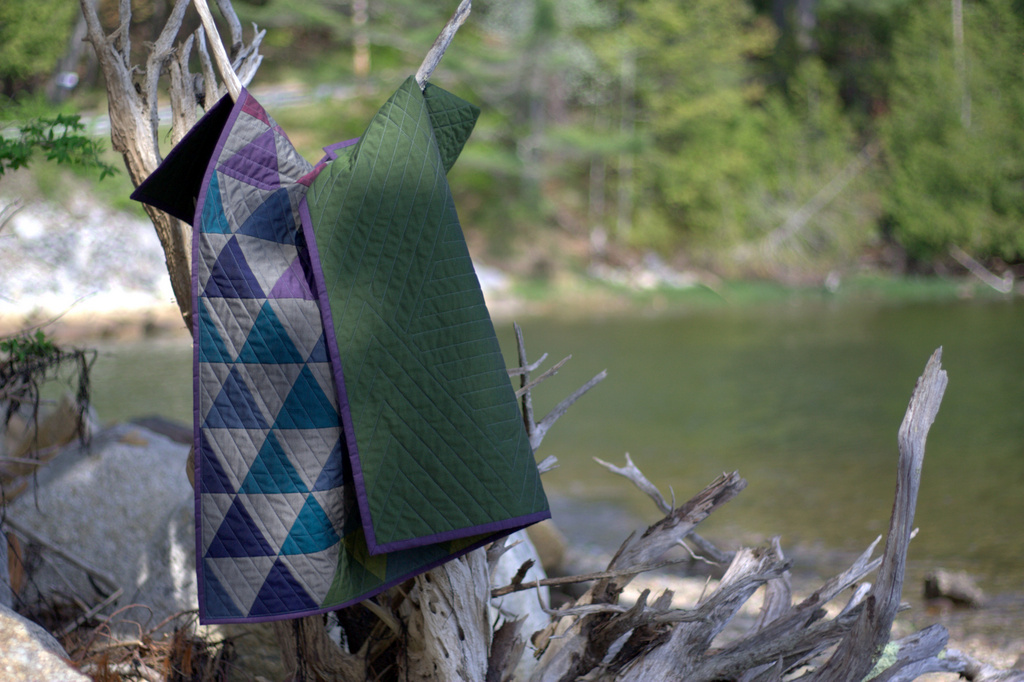
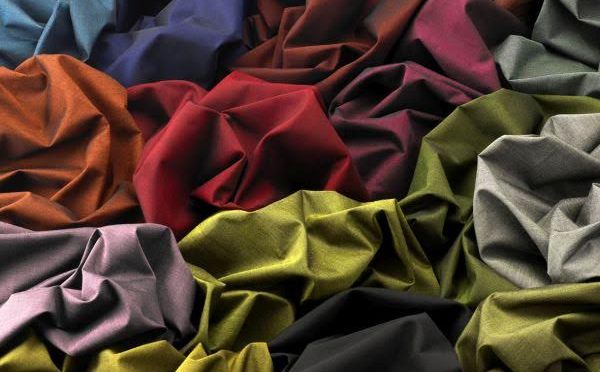
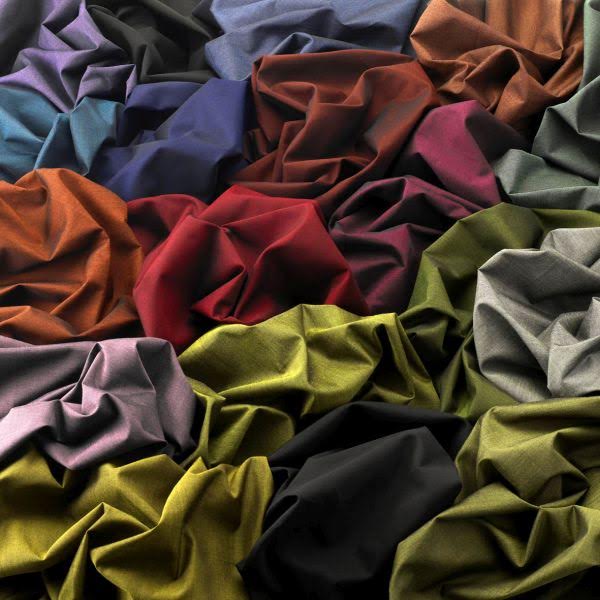
This was my first time working with Oakshott fabrics, and they are so luxurious! They are a woven fabric and feel almost silky to the touch. They feel more substantial than other shot cottons I’ve used, and the Lipari line looks iridescent since the warp is black and the weft is a bright jewel tone. These fabrics come to life when you see them in person–photos truly don’t do them justice. The Lipari line was inspired by volcanoes and the description from Oakshott says it best: “Lipari perfectly captures the primordial beauty of the Aeolian islands. Its luminous colours mirror cobalt seas, lush greenery, pink bougainvillea and shimmering sun; a beauty shot through with dark, fine-grained volcanic rock and black sand.” As soon as I read this description, I knew my quilt had to be a reflection of this volcanic inspiration. Thus, my Vesuvius quilt was born.
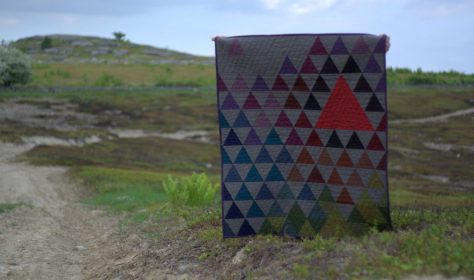
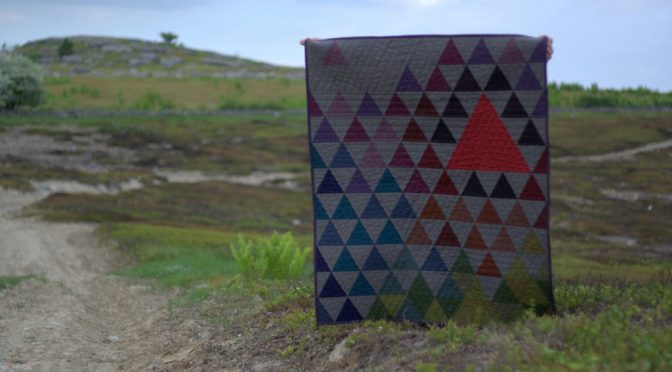
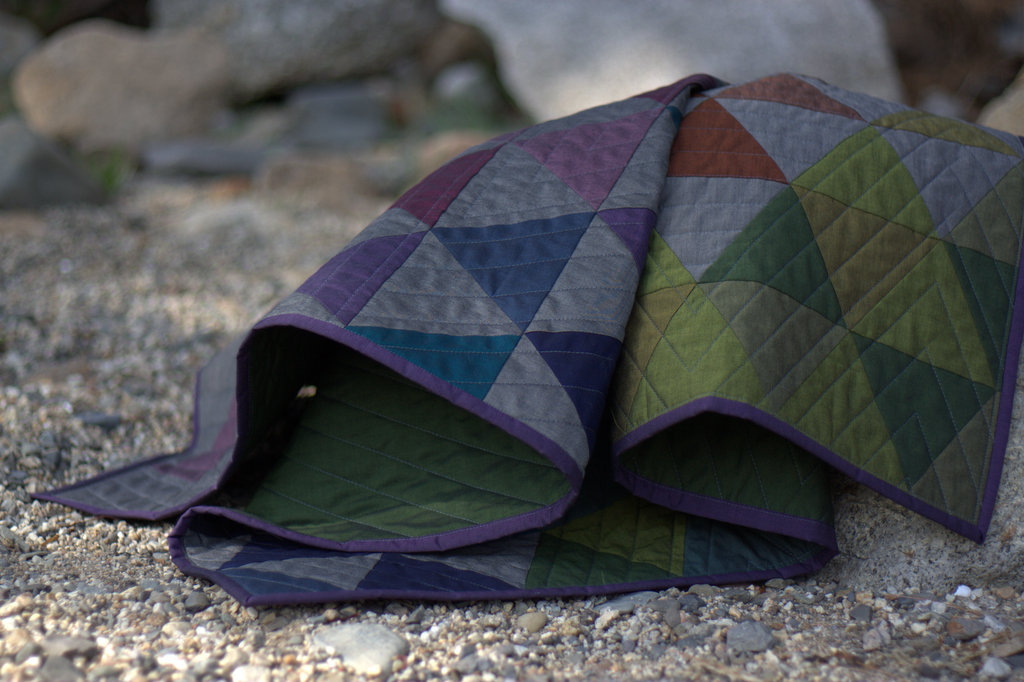
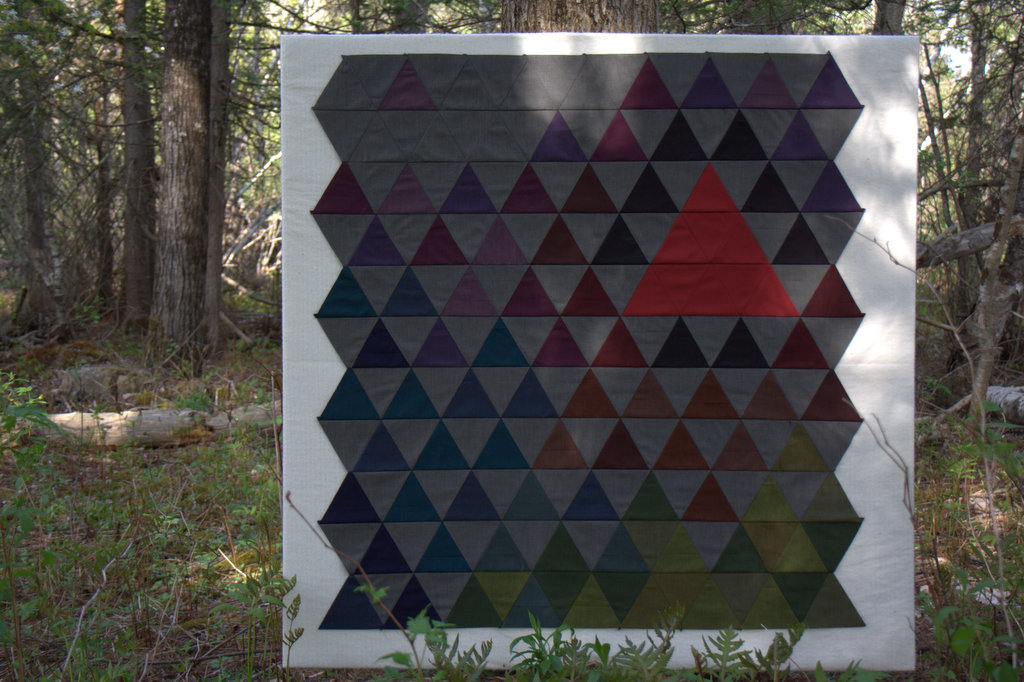
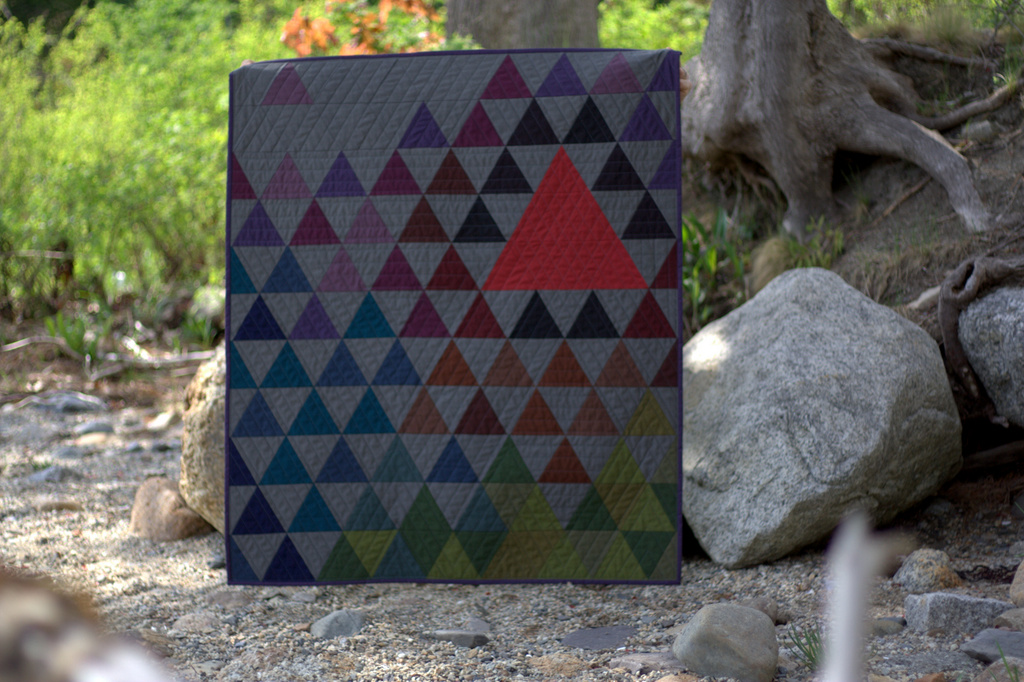
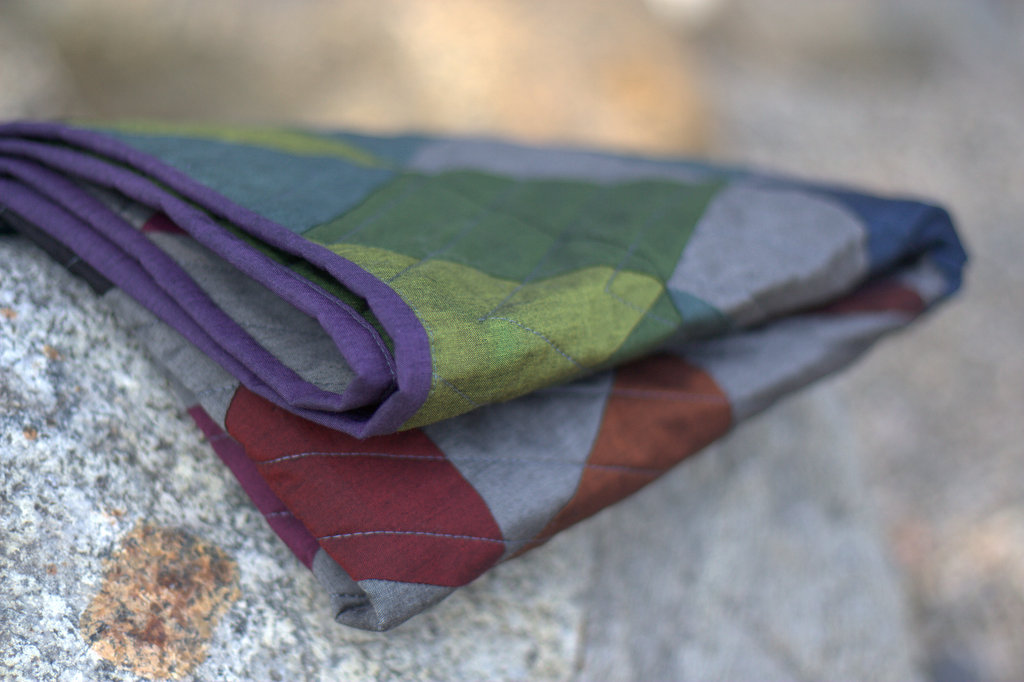
I made my Vesuvius quilt with 60 degree triangles, to elicit the sharp peaks of the mountainous volcanoes. I pulled in some Ruby Red – Toledo for the molten focal triangle, and let the Lipari steal the show. I used my Sizzix die cutting machine to speed up the cutting process. I really wanted to photograph this quilt next to a volcano, but I had to settle for some blueberry barrens and a Maine coast beach.
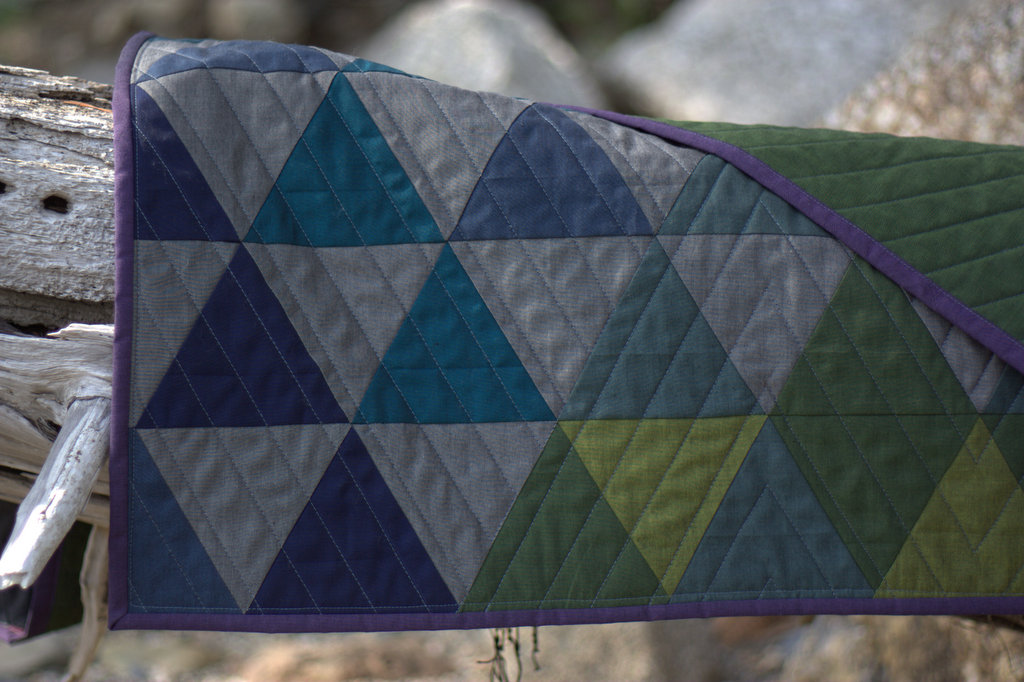
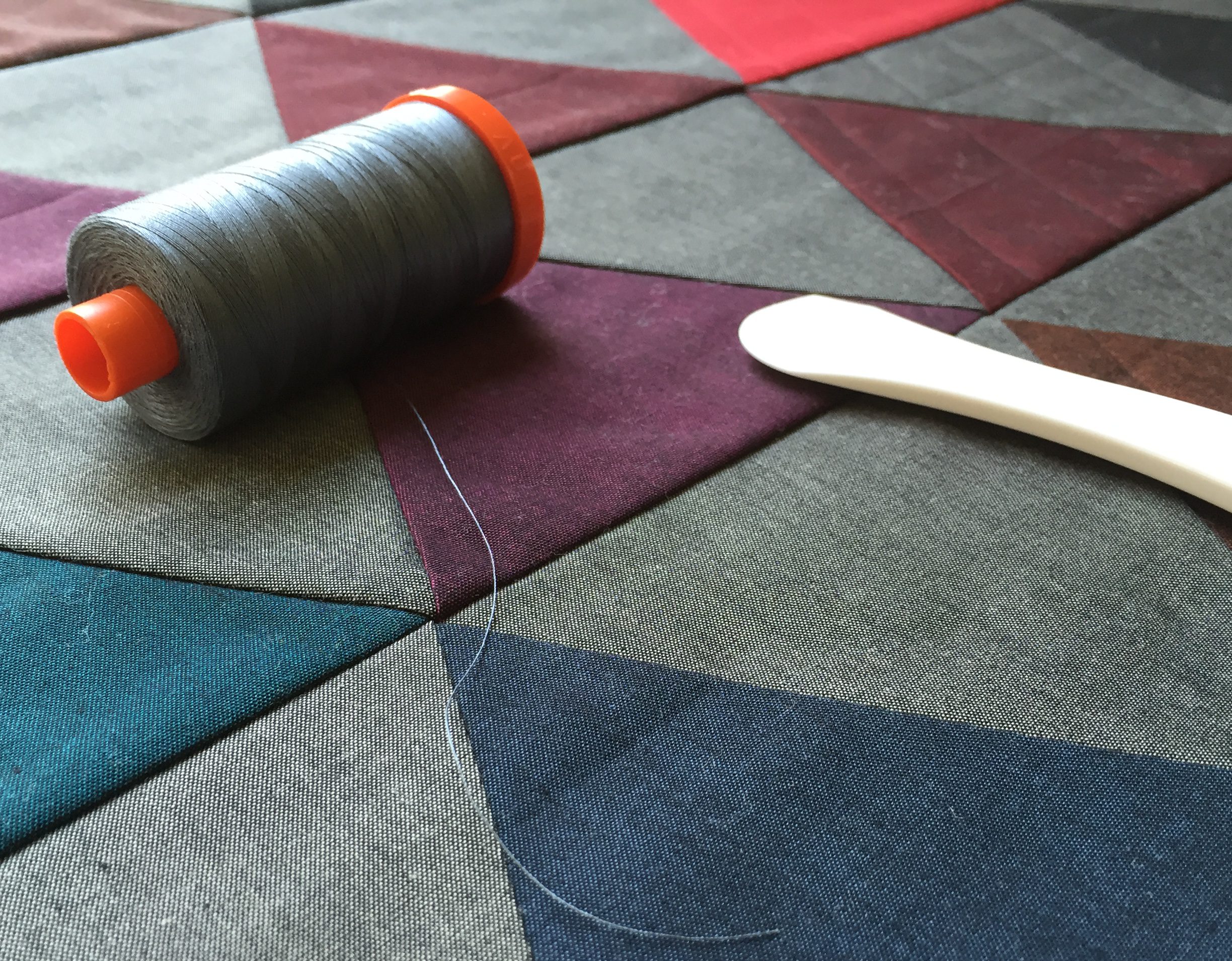
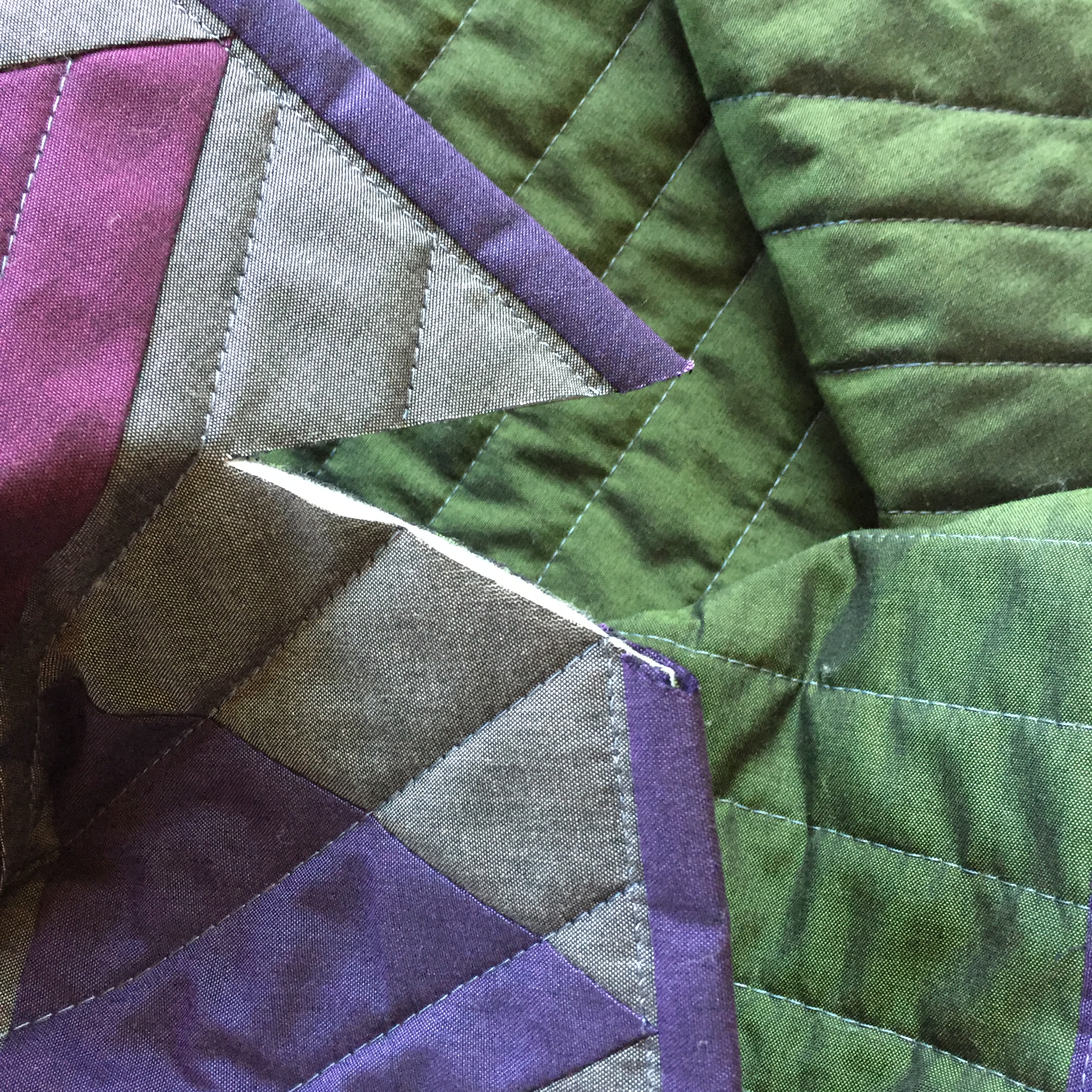
I quilted Vesuvius with 50 wt Aurifil thread 1246-Grey, which blended wonderfully with the Lipari Pollara (grey) I used as a background color. I used the walking foot on my domestic Bernina 560 to quilt straight lines 1″ apart, switching up directions in various sections of the quilt to provide movement and added interest. I LOVE how it turned out!
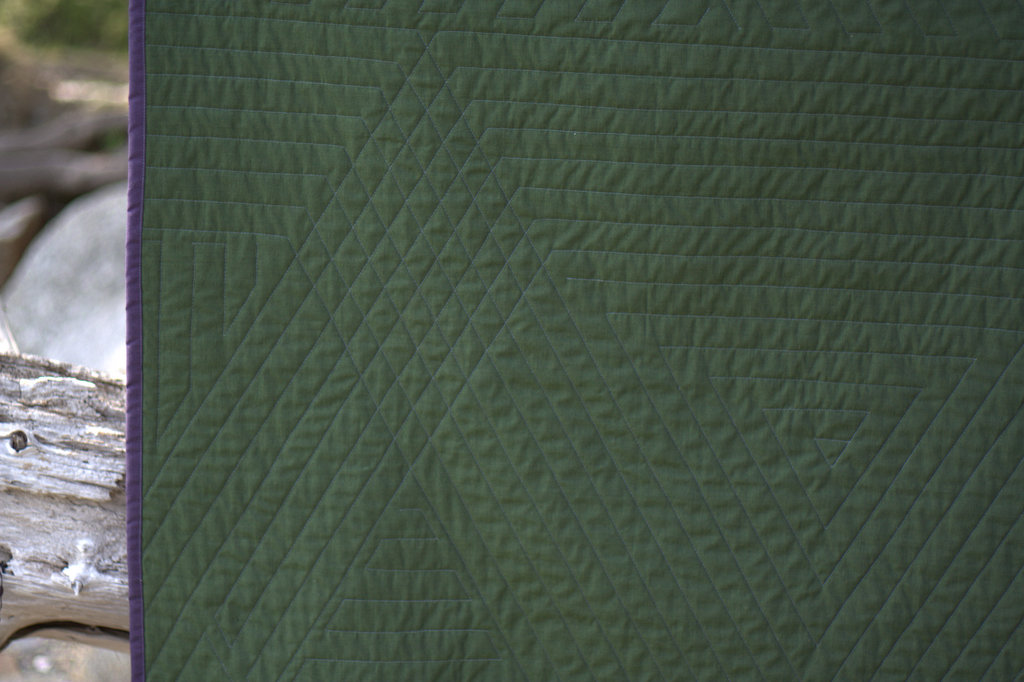
The Lipari Porticello (dark green) backing shows the quilting wonderfully, although it’s tough to get the full effect through photos!
I was torn on what color to use as the binding, but decided that Lipari Gallina (purple) frames it nicely.
This quilt finishes at 36″x43″ so would make a wonderful wall hanging or sophisticated baby quilt. You could also add borders to make it larger.
Tutorial
Here’s how to make your very own Vesuvius quilt! (Note that Oakshott Lipari fabric is 54″ wide. Typical quilting cotton is approximately 42″ wide, so plan accordingly)
Materials
A fat eighths bundle of Oakshott Lipari
1/8 yard of Oakshott Ruby Red Toledo
3/4 yard additional Lipari Pollara (grey)-negative space
1 1/4 yards Lipari Porticello (dark green)-backing
1/3 yard Lipari Gallina (purple)-binding
42″ x 50″ piece of batting
Sizzix die cutting machine
Sizzix XL Triangle, Equilateral 4 3/4″ x 5 1/2″ unfinished die
–OR–
Rotary cutter, cutting mat with 60 degree lines, and ruler
Thread (I used Aurifil 50wt 1246-Grey for both piecing and quilting)
Sewing machine with a walking foot (I use a Bernina 560)
Rotary cutter
Hera marker
Pins
Small thread snip scissors
Cutting
Using your method of choice (see below for instructions for each method), cut the following number of triangles from each fabric:
88 grey (Lipari Pollaro)
9 red (Ruby Red Toledo)
From fat eighth Lipari bundle:
20 purples
27 greens/yellows
12 browns
19 blues
4 black-red
8 black
Using a Sizzix die cutting machine
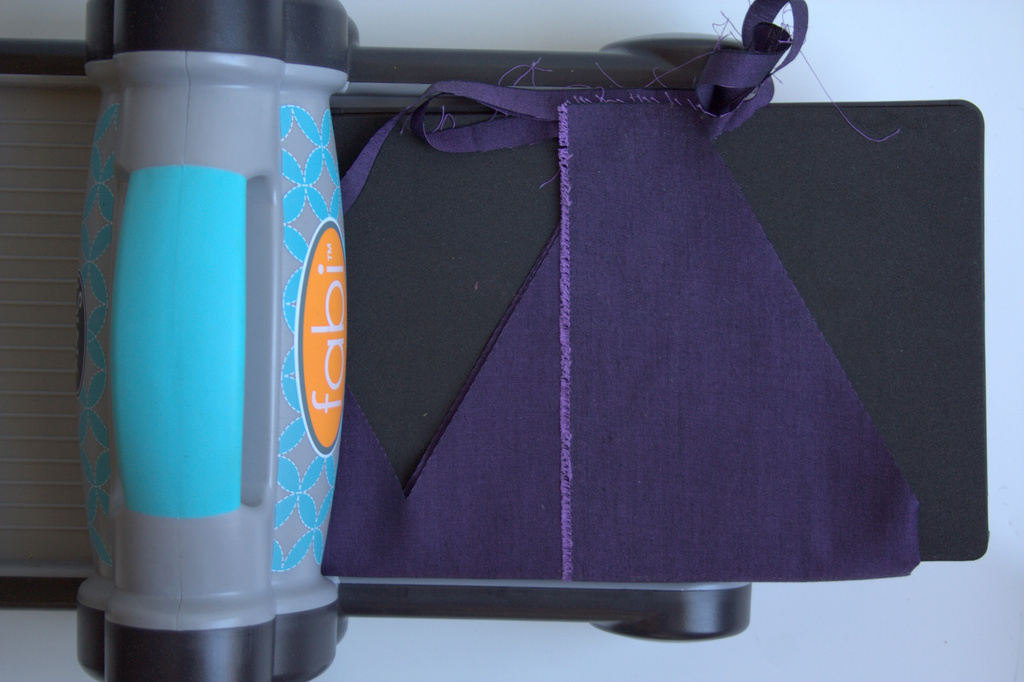
I used my Sizzix Fabi and BigZ Triangle, Equilateral 4 3/4″ x 5 1/2″ unfinished die to speed up the cutting process.
When using your sizzix, cut 5″ x width of fat eighth strips of fabric of each color, fold them over the die blade in the Sizzix cutting sandwich (bottom cutting pad, die with the blade face up, fabric, top cutting pad), and cut 9 triangles at a time. Note that the Oakshott fat eighths are 10″ x 27″, which are larger than a typical quilting cotton 9″ x 21″ fat eighth.
After passing each strip of fabric through the Fabi die cutting machine, you can reposition the remaining fabric and cut triangles from the “scraps”.
If you don’t have a Sizzix, read on to find out how to cut 60 degree triangles with your rotary cutter, using the lines on your cutting mat.
Using a rotary cutter and the lines on your cutting mat
First, cut strips 4 3/4″ by width of fabric. *Note: You can leave the fabric strip folded in half or doubled up if you’re using the width of fat eighth strips, allowing you to cut two triangles at a time!
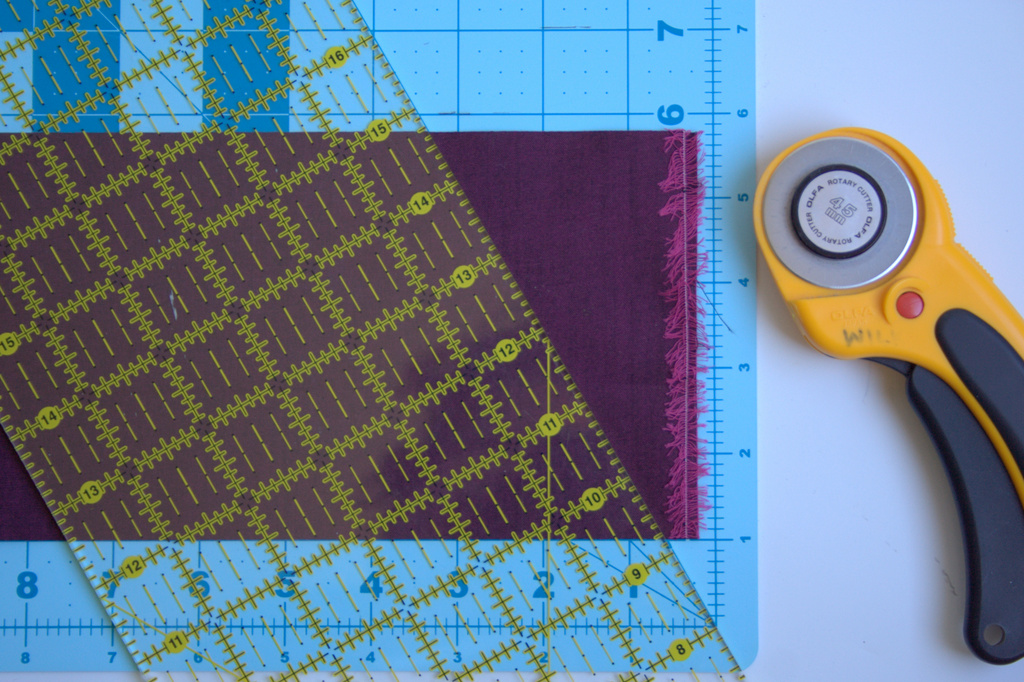
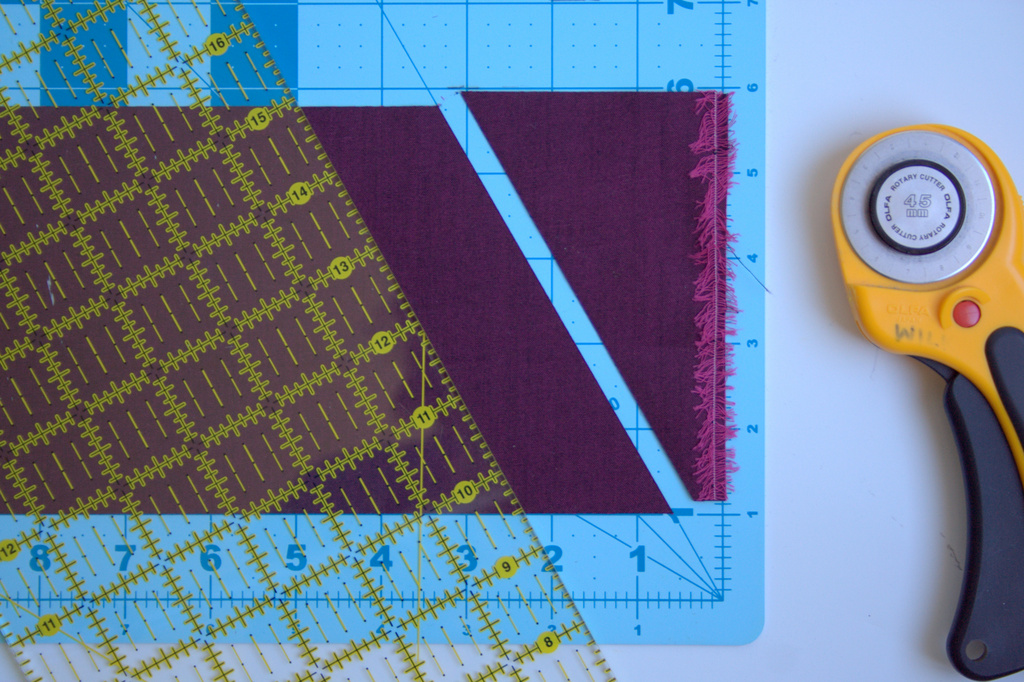
Find the 30 degree line on your cutting mat. Yes, we are making 60 degree triangles by cutting along the 30 degree line (You have a 90 degree square to begin, trim off 30 degrees, then you’re left with 60 degrees!)
Align the bottom of your fabric strip along the 1-inch line. I use the 1-inch line so that you can see where the 30 degree line extends above and below the fabric. Place the edge of your ruler along the 30 degree line.
Using your rotary cutter, cut your fabric on the ruler angle.
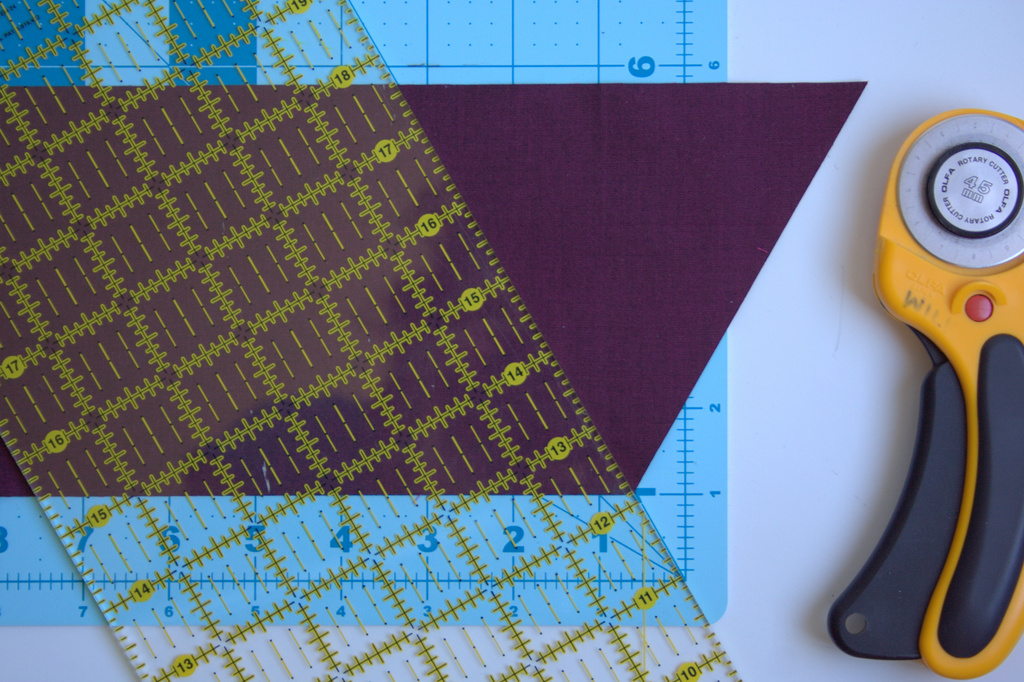
Flip your fabric strip over, then align the bottom edge with the 1-inch line on your mat, so that the bottom point of your cut is on the 30 degree line.
Again, place the edge of your ruler along the 30 degree line. Using your rotary cutter, cut your fabric on the ruler angle. You now have your 60 degree triangle, or two (2) if you kept your fabric strip folded in half. Cut as many as you need.
Piecing the Quilt Top
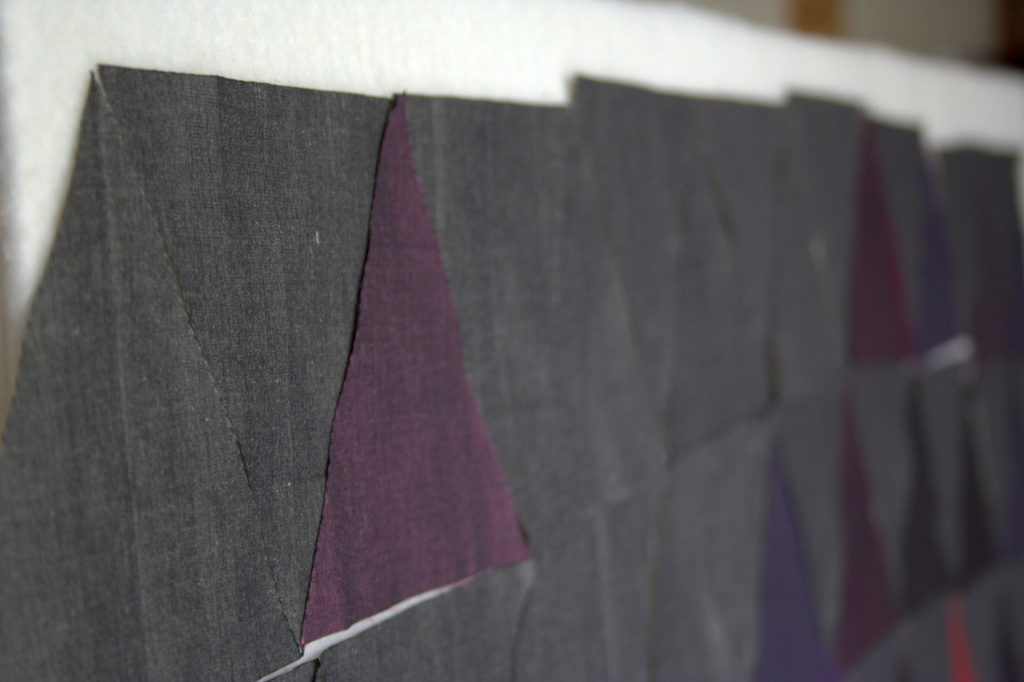
Once your pieces are cut, lay them out as shown. A piece of batting wrapped around a large wall board works well, but I have been often known to use my design floor to help with layout, too! (SizingNote: if you want a larger quilt, you could add a row of grey (Lipari Pollara) triangles to the right and left sides before sewing the rows together to maintain the outer triangle points when adding borders. Then, trim square and add rectangular borders to the desired size.)
Be sure to keep the grain of fabric running top to bottom (the woven texture of the Oakshott Lipari makes this easy to do since the grain is clearly visible when the fabric is held up to the light). Once your pieces are laid out as desired, it’s time to sew them together! Chain piecing helps the process go quickly and smoothly. Here’s how to set it up.
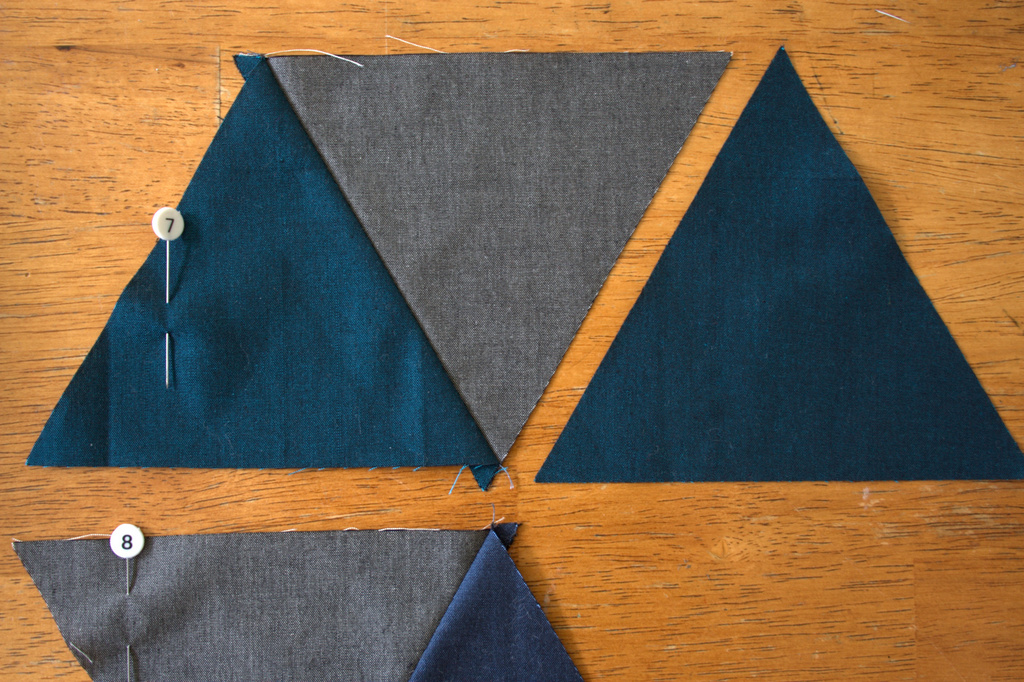
Label each horizontal row. I began with 1 on the top and ended with 11 on the bottom and used pins to label the first piece in each row (Note that I labeled each row after stacking, so the pins aren’t visible in these photos).
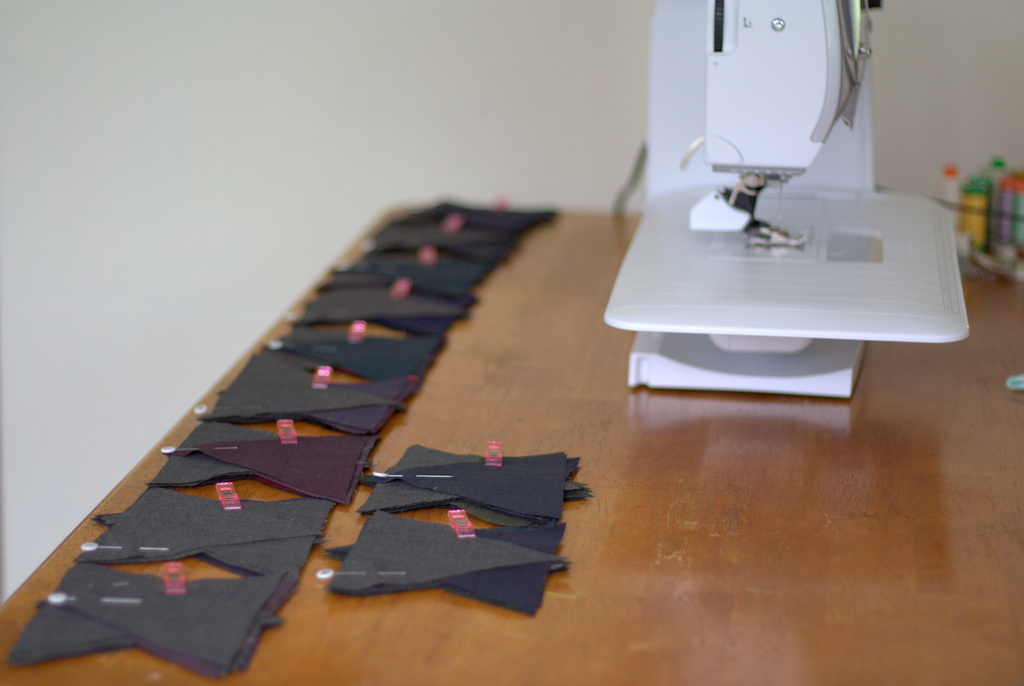
Carefully stack the triangles from each row, with the far left piece on top, and keeping the triangles facing the proper direction (this will help you keep them straight while piecing). For example, for row one, you will have the labeled first triangle piece from the far left on top, and carefully pick up each triangle across the row, adding it to the bottom of the stack.
Once you have your row stacked, use a clover clip or similar device to hold the stack together.
Gather all of your rows in this manner.
Lay them out in order, making a clear mental note of what row is located where. You could label a sticker on the table next to each stack to help, although simply keeping them in chronological order works well for me. Let’s sew! (Note that a table next to you works better than having the stacks this close to the sewing machine. As you add pieces, your strips will drag your stacks around if you keep them here as shown!)
To speed up the process, we will be chain piecing (sewing without stopping) the first piece to the second piece from every row. Note: Be sure to keep the pin labeling each row in the first block at all times!!
Once you have all of your first pieces sewn to your second pieces, trim the threads to separate, and press. All these bias edges means this is a great time to practice pressing, and NOT ironing. Press: up, down, up. Great!
Alternate which side you press your seam for each row. I pressed odd rows (1, 3, 5, etc.) to the left and even rows (2, 4, 6, etc.) to the right. Pressing open also works well!
Next, add the next triangle to each row, chain sewing again. You’ll be sewing the third triangle (which is now on top of each stack) to each row. Double check the number pin on the sewn row before adding the next triangle, since you want to be sure to keep your gorgeous layout intact.
Continue chain piecing, trimming, pressing, and chain piecing again until all of your rows are assembled. As you add each triangle, stack those corners and everything will be right in line!
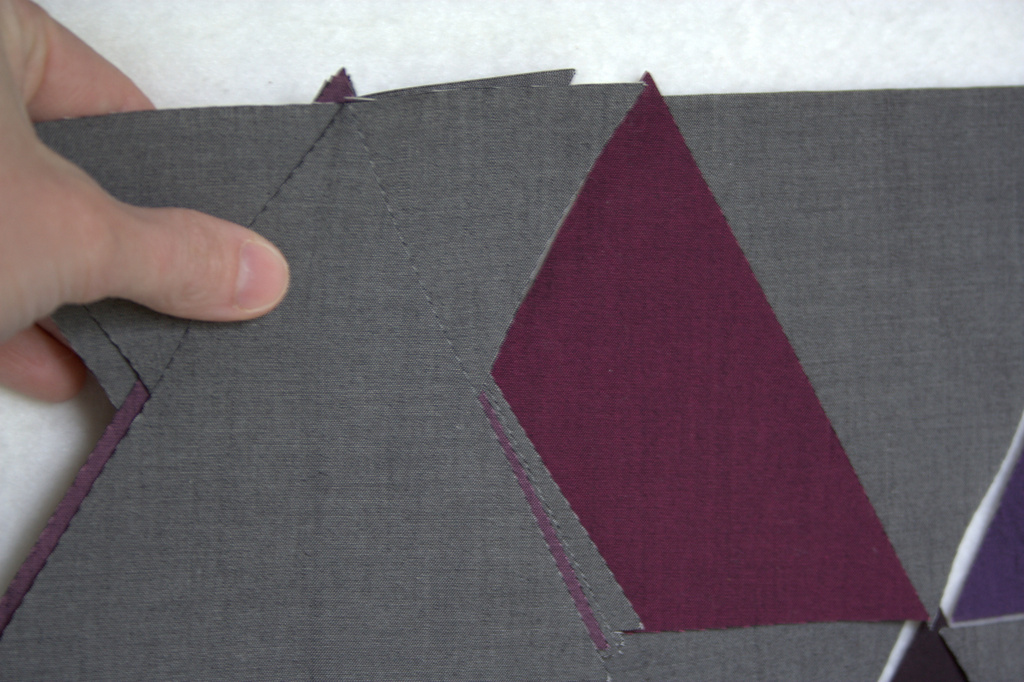
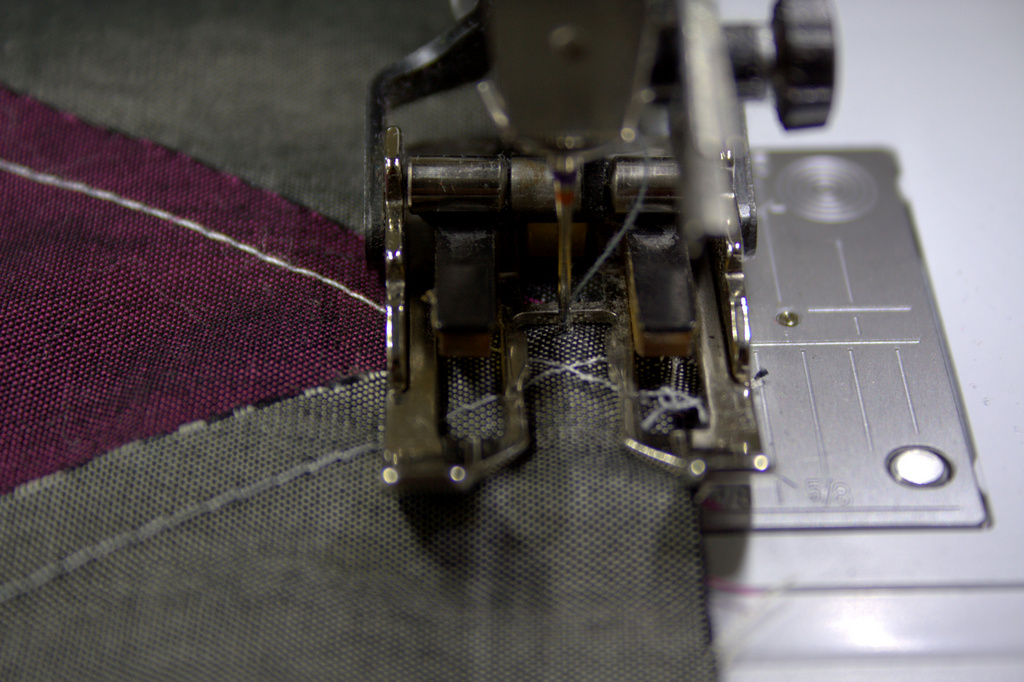
Sew all of the rows together, pressing seams up toward the grey triangles. I like to pin about 1/8″ after each point where the triangle points will be matching up, and aim to sew *right* through the center of the seam-cross to make sure you don’t cut off any points when sewing the rows together.
Quilting & Finishing
Once your quilt top is pieced, baste as desired. I decided to quilt my quilt before squaring it up because of all of the bias edges. I used 505 basting spray and spray basted for the first time! I used Christa Watson’s design wall spray basting tutorial and can see why people love it.
I decided to quilt my quilt with straight lines 1″ apart using the walking foot on my Bernina 560. I used a hera marker and a long quilting ruler to mark lines 1/2″ from some seams, and then 1″ apart from there. I sectioned the quilting in a few different sections, using straight lines 1″ apart but changing directions in each section. Lines intersect in the Ruby Red triangle, “exploding” out to the sides (like a volcanic eruption!?). The quilting lines don’t intersect anywhere else in the quilt. I really love the finished effect.
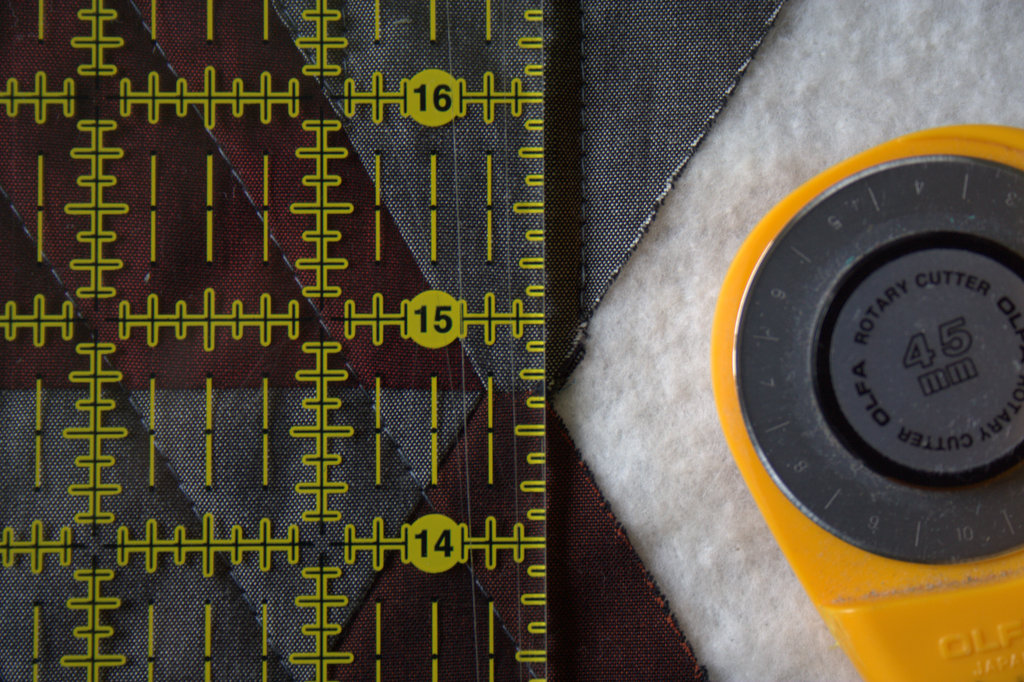
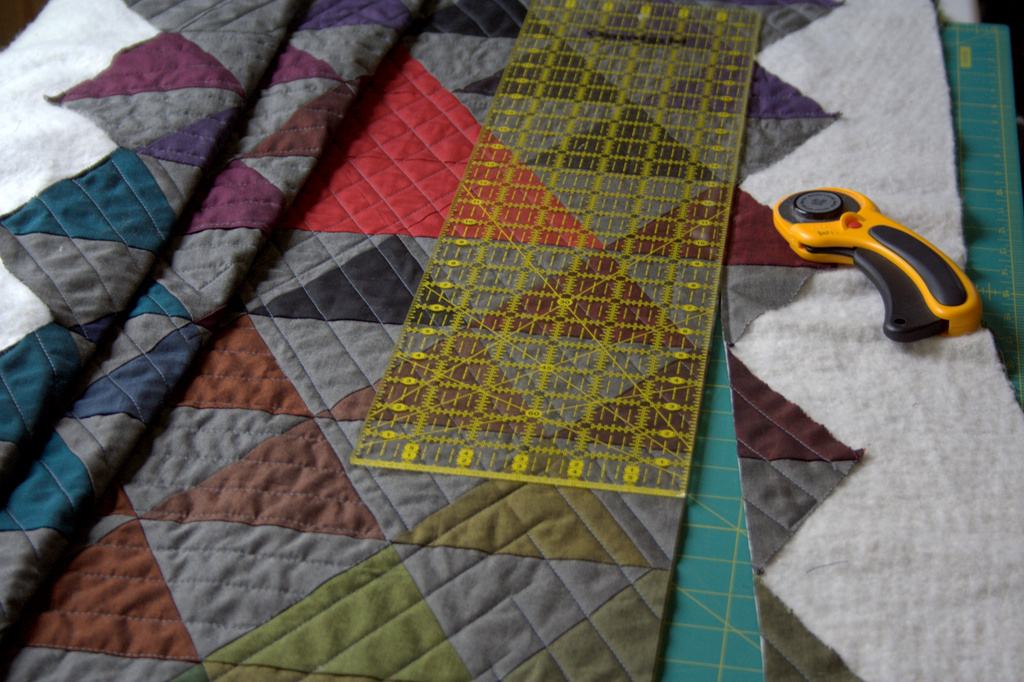
After quilting, it’s time to square up the quilt. Using a long, straight edge, trim 1/4″ away from the outer points so that you don’t lose any points when you sew on the binding. Use at least two sets of points to make sure your ruler is straight before cutting.
Square up your quilt, trimming off the excess, then bind!
Viola! Enjoy your Vesuvius Quilt, and please use #vesuviusquilt and tag me @nightquilter if you decide to make one.
Many thanks, again, to Oakshott for providing the fabrics for this project, and for including me in the hop. Make sure to check out the rest of the amazing Lipari projects:
*BREAKING NEWS* Volcanic action alert
For those of you who follow me on Instagram, you may have seen the heart-wrenching fate of this quilt, that I so unknowingly aptly named “Vesuvius”: my nearly-four year old son cut into it in three places (along with a trail of destruction that included my Machinger quilting gloves cut into pieces and cuts into a big chunk of fusible fleece). With the great outpouring of support, commiseration, and suggestions offered by the fantastic community on IG, I’ve decided to make the cuts an added design element, another chapter in the story of the quilt, and sew either black or red patches over the cuts, making them into “fault lines”.
One of three cuts, now called “fault lines”, made into the edge of this quilt by my nearly-four year old son.
For now, though, I will put the quilt aside until I can dive into the repair with chuckles and reminiscence instead of lingering tears and frustration. I know that my son did not cut into my quilt maliciously, but it still is a difficult experience. I have made it known that if he ever wants to cut fabric again, he can tell me and I will help him make a quilt. We’ll see where it goes. For now, my Vesuvius Quilt (aka Max’s Fault Lines) is smoking and being buried by ash for a bit. It will rise again some day in the future.
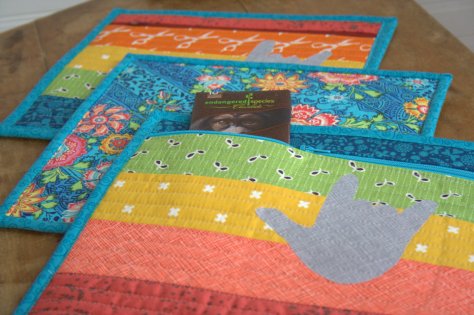
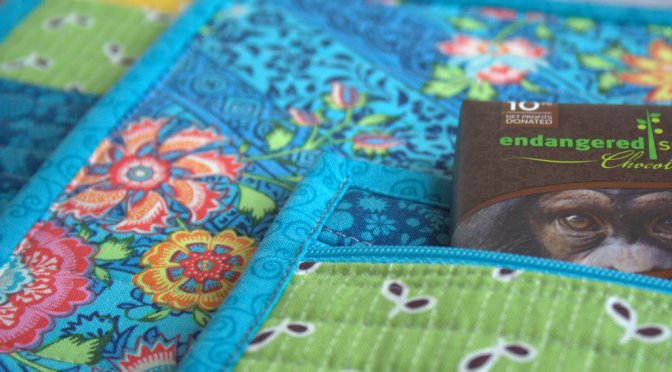
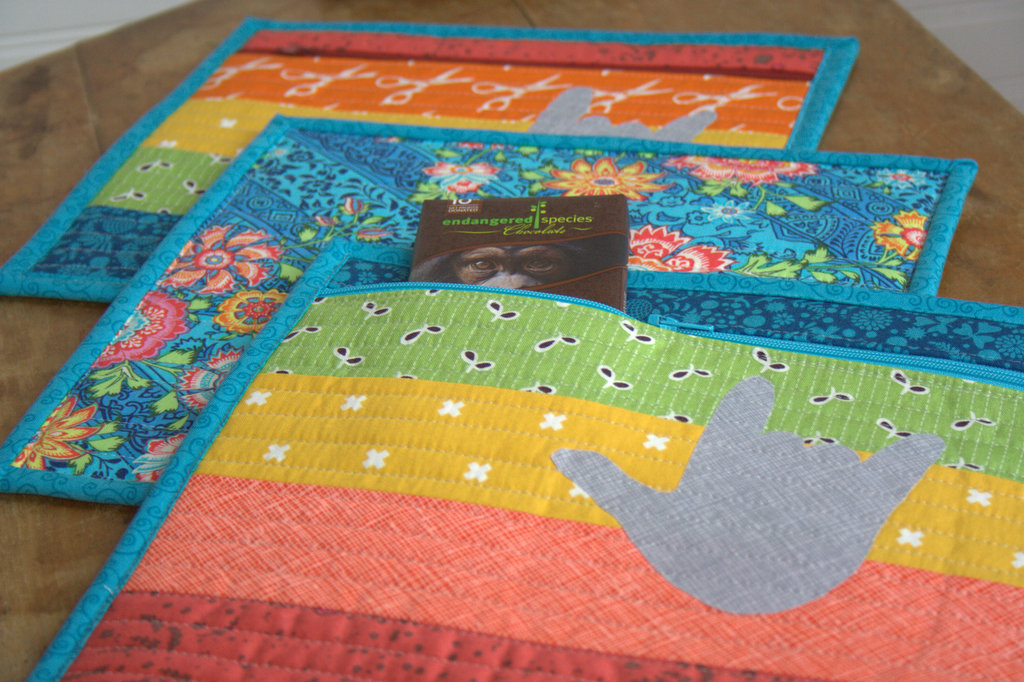
The school year is winding down, which means teachers’ gifts are at the forefront of my mind (along with excitement–and trepidation!–at the prospect of summer adventure day trips with all three kids). When Fat Quarter Shop invited me to join this Simper Zipper Bag Sew Along, I thought it would be a perfect teacher’s gift project. I stitched up three of the large zipper bags, added some chocolate and a personalized thank you note from my 3 year old son, and viola! Perfect heartfelt teachers’ gifts!
These zipper bags are SO easy to make, and Fat Quarter Shop has a very clear instructional video tutorial that you can find here:
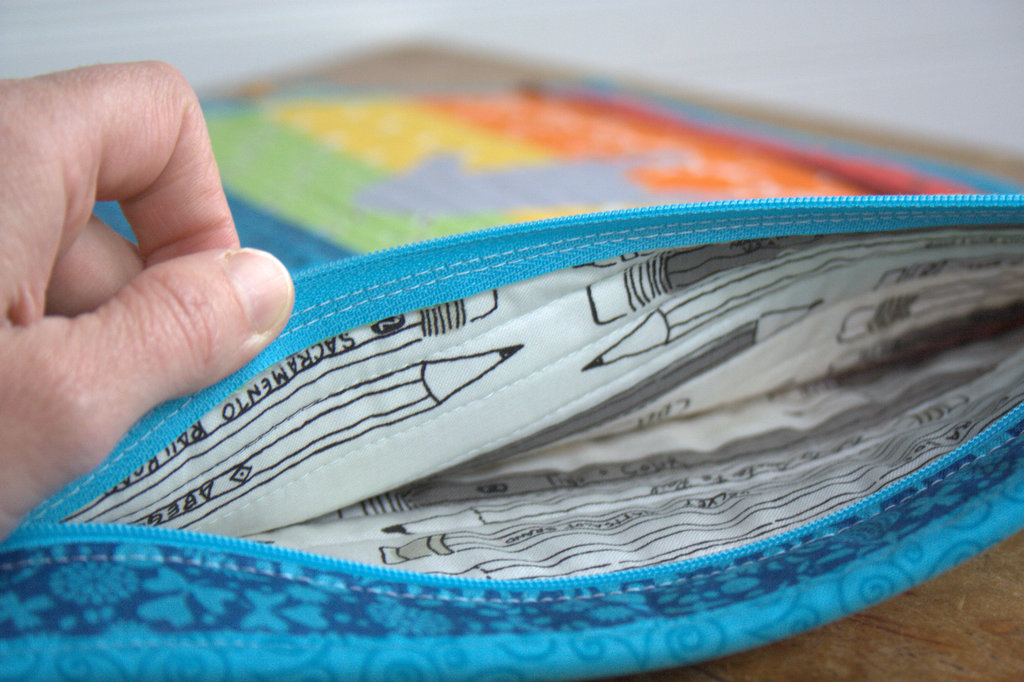
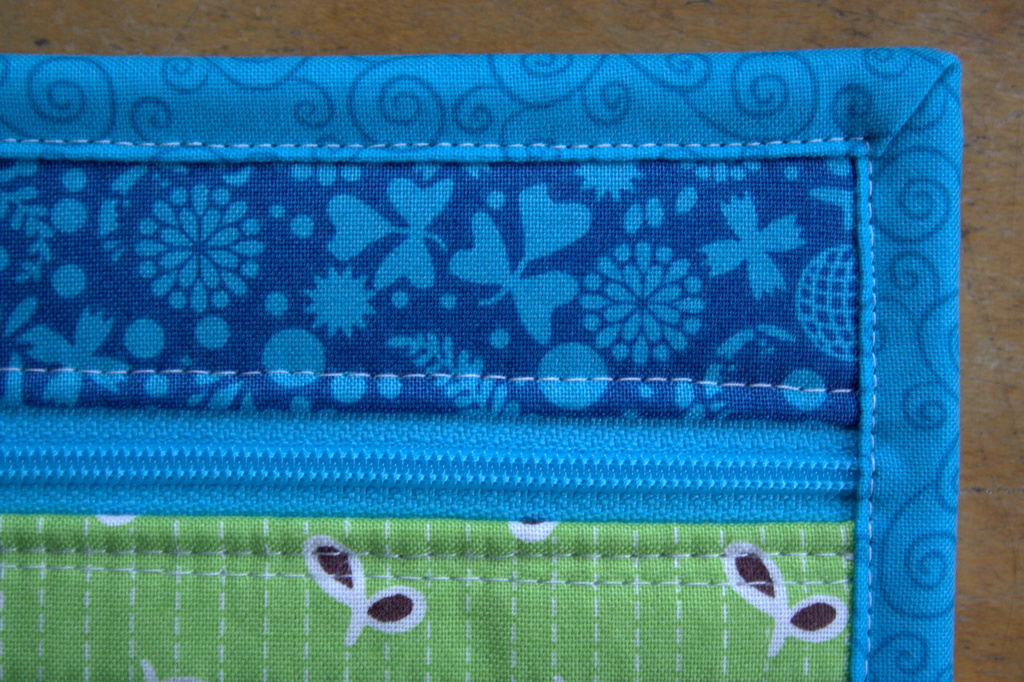
The construction of the bags is brilliant, since the lining and the outer panels are quilted together and then simply sewn together and bound–so easy! I definitely will be going back to this pattern for future gifts, and I’m thinking of making a few more to stash coloring supplies for my kids in my purse for when extra entertainment is needed.
This is admittedly the first time I’ve made handmade teachers’ gifts, but my son’s preschool teachers have done such a fabulous job supporting and guiding him this year, that I felt I really wanted to express my gratitude. When I asked Max if he had any idea what colors might be his teachers’ favorites, he said, “Alllllll the colors!” That’s my boy. I figured I probably couldn’t go wrong with a rainbow-esque bag, especially for preschool teachers.
I decided on a gorgeous Amy Butler fabric from my stash for the backings and then used it to pull a coordinating rainbow of some of my favorite fabrics. You can see Alison Glass, Carolyn Friedlander, Cotton + Steel–they’re all there!
I chose to use strips of fabric instead of mini charm squares, and arranged the fabrics in a way that worked with the three zippers I had on hand, making each bag unique while still having the same general aesthetic. I used the edge of my walking foot to space horizontal straight line quilting on the front, using my go-to thread, 50wt Aurifil 2600-Dove. It blended perfectly with the “I love you” appliquéd hand while providing some subtle texture and interest to the rainbow fabrics.
I lined my bag with an appropriate Cotton + Steel print, Study Hall in Black and White from their Black and White Collection.
I love the neat detailing that results with the construction of this bag. Sewing in the zipper is made SO easy, and the top stitching frames it nicely.
More about that “I love you”; I think the American Sign Language (ASL) sign for “I love you” is known pretty universally, but in case you’re not familiar with it, the appliqué on each pouch is a tracing of my son’s hand making the “I love you” sign. My son is hard of hearing and wears hearing aids (when we can convince him to keep them in), and so he has a communication facilitator in addition to his two amazing teachers. His communication facilitator was fantastic, signing to him all day to increase exposure and familiarity to sign, since we are all trying to learn ASL as a family, and ensuring he heard directions during the day. The entire preschool class learned some sign language throughout the year, and the three teachers worked so well together to help ALL of the children in class have the best experience possible. When Max gave the gifts to his teachers, the “I love you” appliqué of Max’s hand was met with “awww” and a few misty eyes. I think the zipper bags were a win!
How would you use one of these Simple Zipper Bags? Be sure to visit Fat Quarter Shop and the other bloggers’ posts to see their creative takes on the pattern:
**Note: I wrote this post four (4) weeks ago and between other scheduled tutorials and family sickness, it has yet to be posted. I’m finally scheduling it to post so that it goes up no matter what goes down on the homestead. Spring is in full swing here in Maine, now, so just pretend it is a month ago while reading this!**
Warm, sunny, peeks-at-summer days are popping up here and there, intermingled with some below freezing nights and a bout of snow a couple of days ago. Ahh, spring in Maine! We were able to escape on one last grand adventure as a family of three before my big kids returned from their vacation two weeks ago, and today’s color inspiration comes from our adventures at Popham Beach in Phippsburg, Maine. It’s a bit of a drive away at just over 2 hours, but somehow the stars aligned and Finn slept the entire drive down, making our day joyful and smooth. And such, “beaching it” is the theme of the week; color palettes were created using Play Crafts’ Palette Builder 2.1.
Corresponding solids from left to right: Kona Pewter, Bella Bunny Hill Blue, Bella Prairie Green, Bella Pistachio, Kona Parchment, Bella Etchings Charcoal
Corresponding Aurifil thread from left to right: 2606 – Mist
2560 – Iris 5010 – Beige 5016 – Olive Green 2326 – Sand 1140 – Bark
As soon as we began along the path to the beach, I was drawn to the sea grasses that grew along the dunes. Such perfect little spikes of green popping up through the fine sand, it’s amazing to think that they alone hold the shifting sands in place during the strongest storms. Yet another reminder of Mother Nature’s simple complexity. The soft greens of the grasses and beige tones of the sand give a quiet feel to this palette.
This grass-covered dune was gorgeous as a whole, too, and I was happy to see a nice solid fence and signage clearly explaining the importance of looking without touching (or walking).
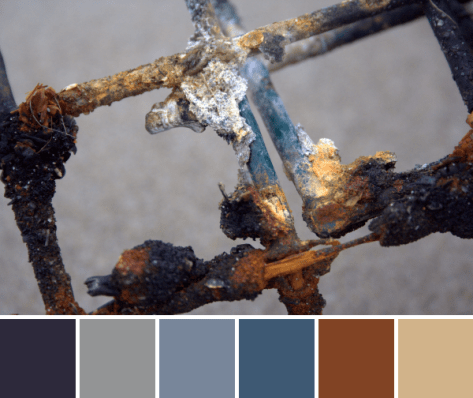
Corresponding solids from left to right: Bella Peacoat, Kona Pewter, Kona Medium Grey, Bella Nautical Blue, Kona Spice, Kona Latte
Corresponding Aurifil thread from left to right: 2785 – V Dk Navy
2605 – Grey 1126 – Blue Grey 1310 – Med Blue Grey 4012 – Copper Brown 5010 – Beige
Great color combinations can be found in the most unexpected of places, like this old, rusty lobster trap that was washed up on the beach and almost entirely covered by sand. I am wishing I took a photo of this from further away, since you might not notice the intricacies of texture and color unless you take a closer look. Lovely rust! I actually have a quilt in the wayyyy beginning phases of planning using a rusty color palette like this. It might become a reality in a year or two!
Here are a couple more photos from our expedition, just for fun:
Check out that amazing driftwood!!
Here’s to another color inspiration post next week, featuring some of the gorgeous spring flowers that are finally filling our gardens! Enjoy your week!
Remember that mini mini quilt craze that spread like wildfire among quilty bloggers about eight months ago? Yeah, me too. The fun news is that with the recent feature in Make Modern magazine, the mini mini quilt spark is being fanned back into life with a Mini Mini Quilt Challenge. You can see a fun inspiration gallery of mini mini quilts in the recent issue of Make Modern (Issue 11), including a couple made by yours truly, and there’s a community wide challenge running now through June 20th to help inspire more mini mini madness. Read more about the challenge here, or check out the hashtag #MMminimini to see what creative mini mini quilts have been created thus far (and add your own to the pool!).
I’d like to say the mini mini quilts I’m sharing today are newly inspired and whipped up in response to this fun challenge, but no. I’ll be honest. I began both of these many, many months ago, and they were worked on at a snail’s pace, off and on. I’m almost embarrassed to share these finishes, since they have taken me so ridiculously long to finally finish. But I know that you understand, and that you would want to see the finished mini mini quilts even if it took over 8 months (gah!) for me to finally buckle down and finish them. So, without further delay, my latest mini mini quilt finishes:
Slow Growth
This mini mini quilt was made for Allison at Campbell Soup Diary (you can see the amazingly wonderful mini minis she made me here and here). When we first decided to exchange mini minis, she offered this as guidance: “As for colors that I like… AG grove in grass green is THE perfect shade! I tend towards pinks, purples, oranges, yellows, but generally stay away from blues unless it’s a really nice royal. Turquoise is great, but red is the one color that is almost always left out of my color palette. (don’t ask me why, but I even avoid it in my garden and my wardrobe) If given the choice between straight lines and wonky, I prefer straight. I love natural and soft shapes, but I also realize that that cannot easily be pieced.”
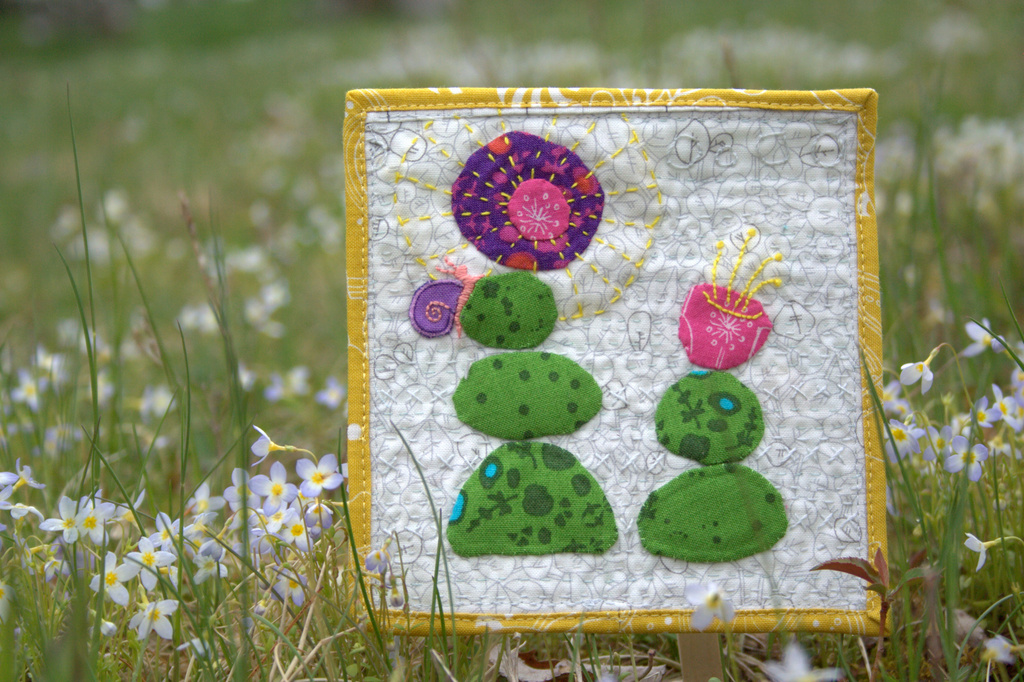
For some reason, I latched onto the AG grove in grass green (of course), paired with the favorite colors of pinks, purples, oranges, yellows. I wanted to create something with natural and soft shapes, so immediately thought of needle-turn applique. The rest of this mini mini just sort of happened as I stitched. The mod leaves and flowers are needle-turn appliqued, and then I used 12 wt Aurifil thread to embroider details on the flowers.
The snail was not initially intended to be part of this mini mini, but in fact was the result of a mini mini travesty: my three year old son found my little scissors and in playing around, cut a small hole right in the mini mini quilt!! After taking many deep breaths, probably yelling at least once and emphatically saying that it was NOT ok to cut mommy’s sewing, I decided to make lemonade out of lemons and needle-turn a little patch over the hole. With a bit of embroidery embellishment, a little slow growing snail was born. It ends up this snail was the perfect symbol of this project, and ultimately inspired its name: Slow Growth.
I densely hand quilted this mini mini with a variety of weights of Aurifil 2600-Dove (50wt, 28wt, and 12 wt), essentially hand-matchstick-quilting the 5″x5″ quilt. I improv-ed the quilting and included a few rows of X’s and one of little bubbly O’s for interest. I used a super thin binding for this (1″ strip to start, single fold), and although finicky to sew on, I really like the feel and aesthetic of the skinny binding. Even if it took ages, there are many positive, grateful, creatively generous thoughts stitched into this mini mini, Allison! I hope you like it!
Too Tiny
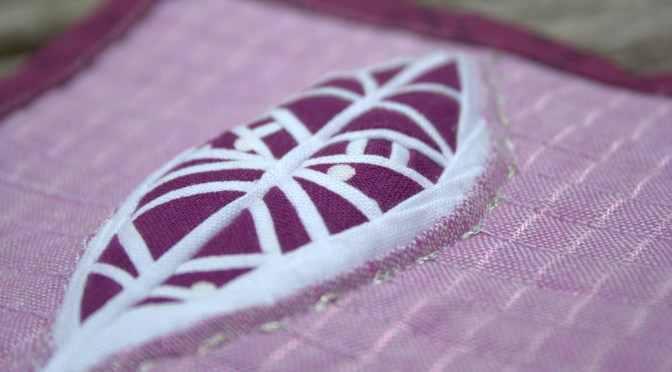
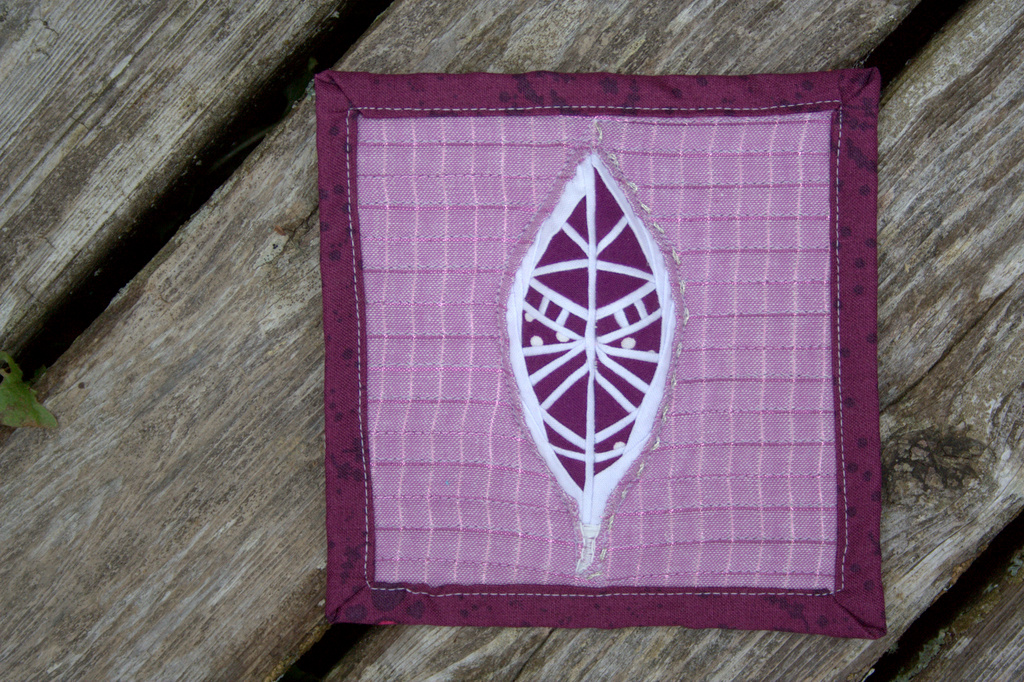
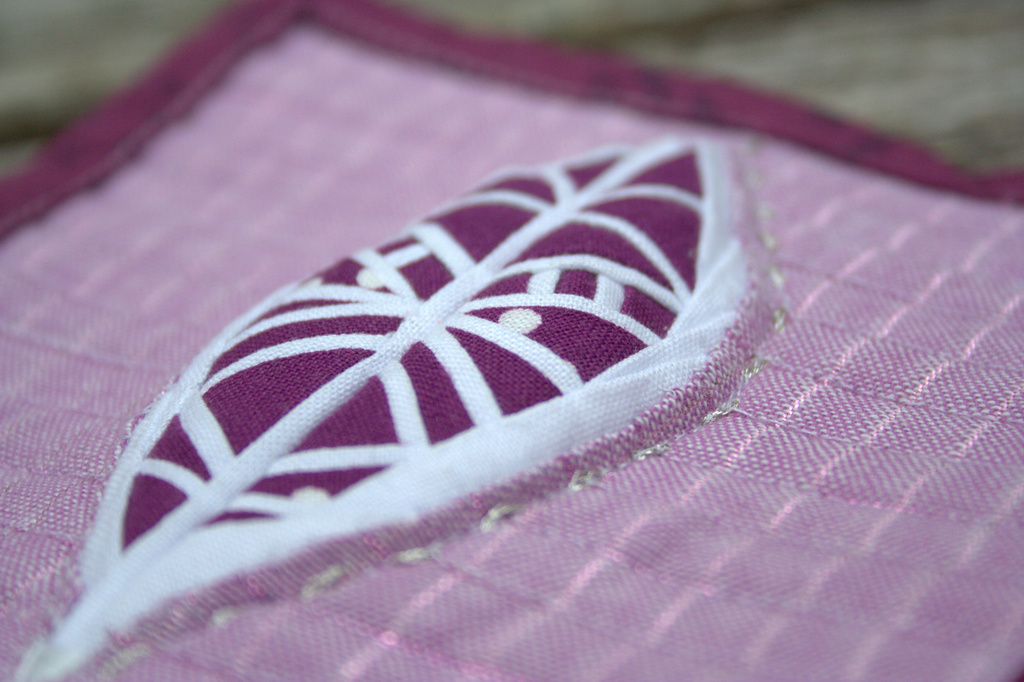
This next mini mini quilt was an experiment in how small can you go, and I determined that I reached my tiny threshold, at least with this foundation paper pieced pattern. The intended recipient of this mini mini is a big fan of the color purple, and I also knew I wanted to make her a feather mini mini. I wanted it to be unique, though, so I designed my own teeny foundation paper pieced pattern of a geometric feather.
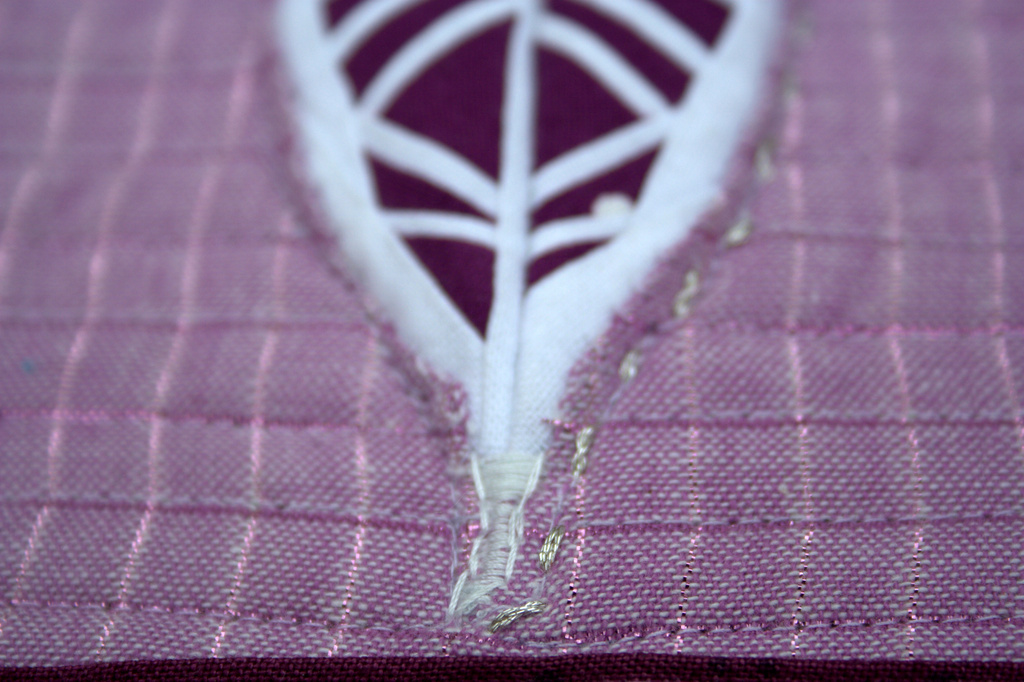
I absolutely love tiny stitching, mostly because of the giggles that reflexively bubble over while I’m piecing the ridiculously tiny pieces. This tiny feather was no different, until it came time to sew the two sides together. The seam was crazy thick; so thick, I had to hand crank my sewing machine to get the needle through it without breaking (I broke a needle trying the first time). With a seam that thick, you can guess how great my chances of pressing it flat might be–slim to none! My solution? I stuffed actual wool batt behind the feather and then quilted around it as best as I could. It’s not exactly trapunto; it’s more a stuffed feather!
My reverse needle-turn applique skills have room for improvement, and the shaft of the feather didn’t work as well as I had hoped. I decided to embroider over it with 12wt Aurifil to try to give it a more intentional look, and I’m much happier with the result. The Anna Maria Horner loominous fabric was the perfect background, and I machine quilted horizontal lines with 50wt Aurifil 2560-Iris.
I used the backing as binding and folded over a larger portion on this mini mini quilt, since I felt it needed a stronger frame due to the visual weight of the 3-dimensional feather. Mini mini quilts certainly keep me humble, since every little stitch is visible, and the wobbles and less-than-perfect corners are part of the charm.
I signed the back with quick embroidered initials and date, since I feel strongly about signing all creations, no matter how small.
Both of these mini minis are going in the mail today. Once I finish a bit more of the projects on my to-do list, I am sure to revisit the mini mini quilt making scene. I still have one more promised mini mini quilt that is in progress for a friend who has already sent one in return (ages ago), and my very first mini mini swap for which I need to redo the binding. I think I agreed to swap with at least two others, but we left it open and relaxed and since I have not received a mini mini in return, I don’t feel *quite* so bad letting the creation of my mini mini quilt slide. All in good time, right?
Have you made a mini mini quilt yet? If you feel so inspired, I encourage you to post a photo on Instagram with #MMminimini to join the fun (and enter to win prizes!). I’d also love to see it, so tag me @nightquilter so that I can see your tiny beauty!
Last night kicked off the International Quilt Market, spring edition, which is in Salt Lake City this year. Much of my Instagram feed is flowing with pictures of sample spree booty, gorgeous booths, and peeks at new fabric lines and products. One product that is being introduced at Quilt Market as we speak is a new Sizzix die called Hex Star designed by Victoria Findlay Wolfe.
I got to play with this die in advance and I’m sharing the project I made with it over on the Sizzix blog today! It included my very first y-seams, rainbow hand quilting with 12 wt Aurifil thread, and a fun go at embroidery quilting (I may have invented that term myself–is it such a thing!?) I share a close look at my hand quilting, a tip for even stitches, and many more photos of the full project here.
Although the mini quilt is bound and finished, I am 99.9% sure I am going to do more embroidery-quilting on the Alison Glass Endpaper outer border. I was debating whether to stick with the colors extending from each arm of the star or to mix it up in the outer border, but I think I’m going to stick with the same colors as the center. I shared more detail photos of the quilting and embroidery in my Sizzix post, so head over to see more!
Here are the 12 wt Aurifil colors I used, just in case you want to try some rainbow hand quilting, too:
5002 – Medium Red
1154 – Orange
2120 – Canary
1147 – Light Leaf Green
4140 – Wedgewood
2540 – Medium Lavender
I’ll be sure to show you when I finally decide it’s really finished. For now, I’m linking up with Crazy Mom Quilts since this mini is technically finished (although is anything ever really fully finished when you have thread in your hand?)
Welcome to the Oakshott Lipari Blog Hop! For those of you who have been following along on this fantastic hop, you’ll notice that today is my scheduled day to share my project made from the newest Oakshott line, Lipari. Unfortunately, due to a week plus of family illness, I’m not quite finished with my quilt. Lynne was kind enough to move me to the end of the blog hop, so you’ll have to wait until June 2nd to see my project and tutorial.
In the meantime, here’s a gorgeous peek at the new Oakshott Lipari line. These woven fabrics have black warp, and gorgeously glowing weft, making them decidedly iridescent. I love how dynamic their colors are, and I’ve drawn from the inspiration for the fabric line itself as inspiration for my quilt (the only hint you’ll get for now!)
I definitely recommend checking out the projects that have been shown already, and be sure to visit the rest of the talented bloggers in the coming weeks to see what they’ve been creating!

 I really love clear video tutorials since I am very much a visual learner. Seeing each step helps make the process smooth and easy to complete without hang up or confusion. That, to me, is a big win!
 I decided to make my pin cushion with a range of warm Alison Glass Sun Prints 2015 and 2016, and once it was finished, it begged to be photographed out in the garden with the peonies. Such vibrant colors need to be in colorful company.
 I used a Tula Pink ribbon I won in a giveaway from Renaissance Ribbons a year or so ago as the ribbon detail, top stitched with Aurifil 40wt 2230-Medium Peony (so fitting!). I topped the pin cushion with Robert Kaufman Quilter’s Linen, which is a fabulous all-purpose blender fabric that happened to coordinate wonderfully. Aurifil 50wt 5022-Mustard was the perfect thread for hand stitching the opening in the Quilter’s Linen closed, too. I just love when perfectly coordinating fabrics and thread can be found in my stash.
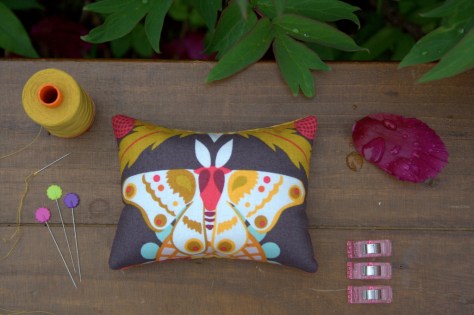 I backed the pin cushion in Ex Libris Bookplate in Charcoal by Alison Glass (Andover Fabrics), and really would be tempted to use the pin cushion upside down every so often, it’s so pretty. This pin cushion is not for me, though, so the recipient can do with it as she pleases!
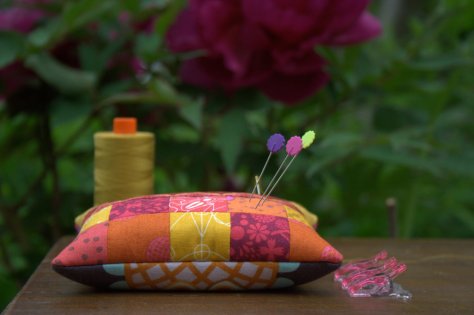 This is the first pin cushion I’ve stuffed entirely with crushed walnut shell, at Sherri’s suggestion, and I really like the sturdiness and ease with which pins go into it. I bought the crushed walnut shell from a quasi-local, fabulous quilt shop, Clementine in Rockland, Maine months ago but had not yet had a chance to use it. Leah at Clementine suggested the crushed walnut shells since the oils from the nut shells help keep the pins and needles sharp and rust free. They also provide a nice, sturdy base for your pins and needles.
 Check out the video below and make your own pin cushion if you want! There’s no such thing as too many pin cushions, right?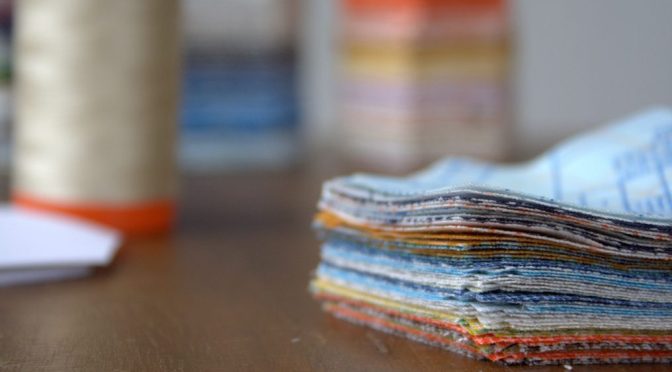
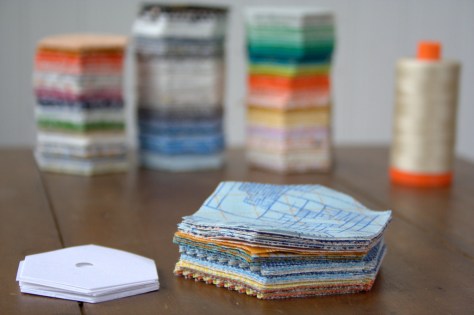 My portable hand stitching kit this summer consists primarily of English Paper Piecing (EPP) hexies and some experimental embroidery-quilting projects.
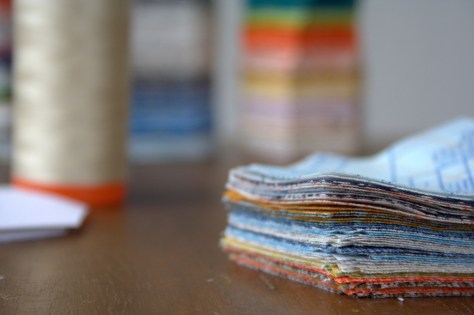 A lovely stack of fabric hexagons ready to baste. I need to cut a few more cardstock templates, but this will do for now!
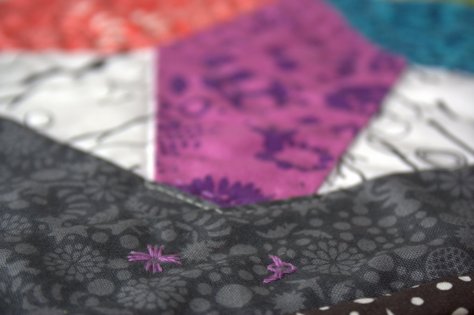 I am also continuing to add embroidery quilting to my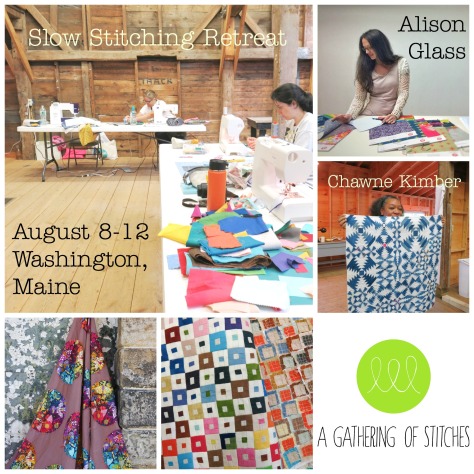



















 Corresponding solids from left to right:
 This grass-covered dune was gorgeous as a whole, too, and I was happy to see a nice solid fence and signage clearly explaining the importance of looking without touching (or walking).
 Corresponding solids from left to right:









 Night Quilter